DRDO tests surveillance balloon prototype
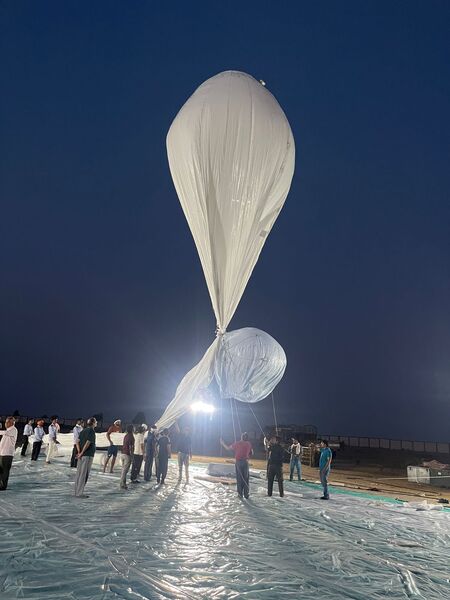

The DRDO has tested a prototype of its Stratospheric Airship Platform that is being developed to enhance intelligence, surveillance, and reconnaissance operations. (Indian Ministry of Defence)
India's Defence Research & Development Organisation (DRDO) has launched and tested a surveillance balloon called Stratospheric Airship Platform from a test site located in the central Indian state of Madhya Pradesh.
This surveillance balloon – developed by the DRDO's Aerial Delivery Research and Development Establishment – carried a payload to an altitude of around 17 km, India's Ministry of Defence (MoD) announced on 3 May.
The data received from sensors onboard the surveillance balloon will be utilised to develop high-quality fidelity simulation models for future high-altitude airship flights, the MoD said.
The Stratospheric Airship Platform flew for around 62 minute. “Envelop pressure control and emergency deflation systems” were deployed in the balloon for their performance evaluation. These systems were recovered by the trial team after the flight test for further development, the MoD added.
India's Defence Minister Rajnath Singh said the Stratospheric Airship Platform will enhance the Indian Armed Forces' Earth observation and intelligence, surveillance, and reconnaissance (ISR) capabilities.
Chairman of the DRDO Samir V Kamat said the flight test of the prototype is part of the DRDO's efforts to develop “lighter-than-air high-altitude platform systems that can remain airborne for very long endurance at stratospheric heights”.
The Stratospheric Airship Platform can be categorised as a high-altitude pseudo satellite (HAPS) platform. According to NASA, HAPS platforms can be divided into two broad categories: heavier-than-air systems such as fixed-wing aircraft, and lighter-than-air systems such as balloons.
Go beyond the headlines - with direct links to interconnected entities
Get full access to validated equipment, military capabilities, and market insights.