Northrop Grumman demonstrates DARC Site 1 capabilities
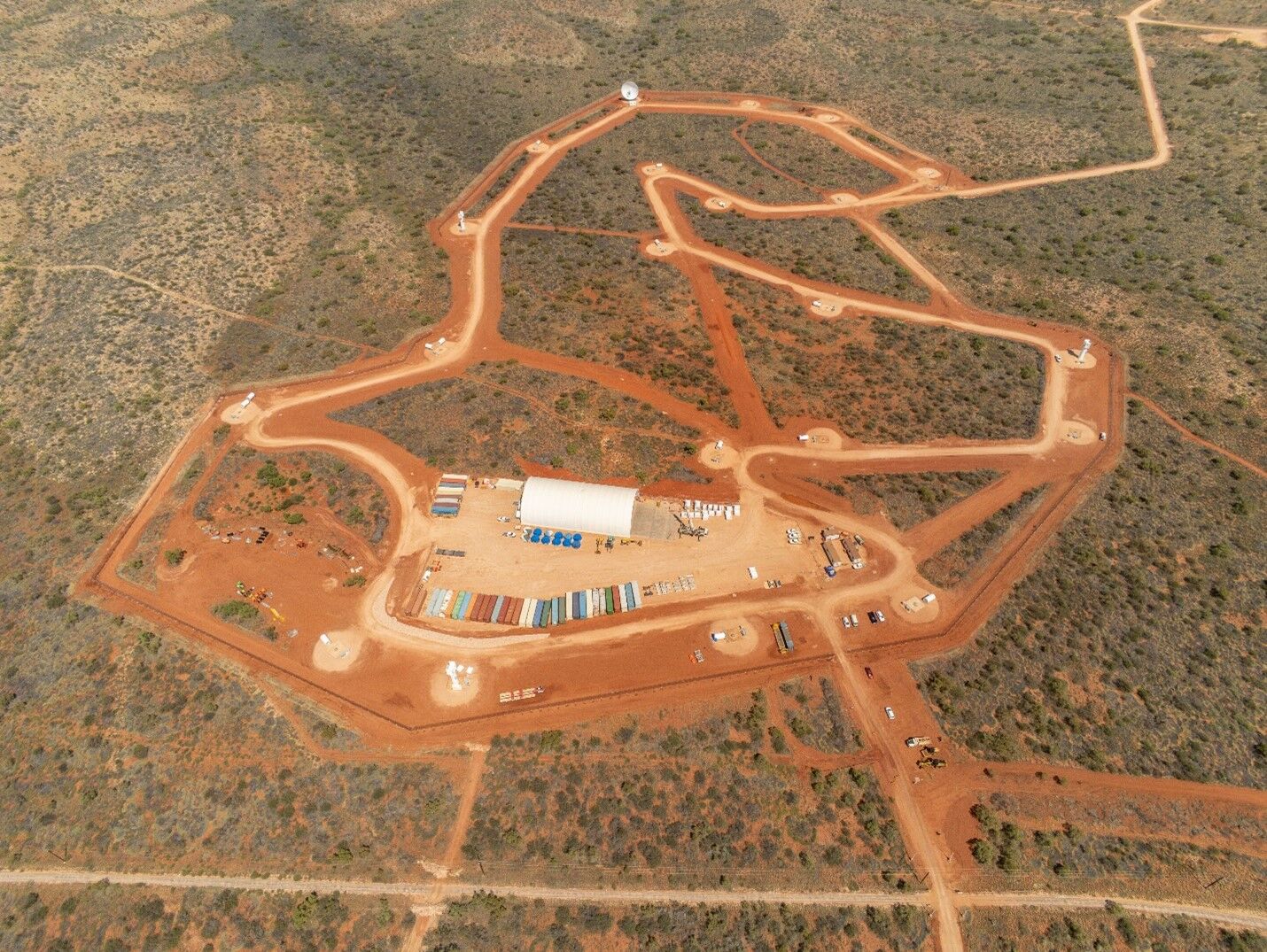

An aerial photograph showing the DARC Site 1 receive array station in Western Australia. (US Space Force)
Northrop Grumman in collaboration with the US Space Force (USSF) has tested antenna arrays it developed for a Deep Space Advanced Radar Capability (DARC) in Western Australia.
Located at Naval Communication Station Harold E Holt in Exmouth, this is the first of three DARC facilities being established to enhance joint space domain awareness (SDA) of Australia, the United Kingdom, and United States under the AUKUS security partnership. The second and third DARC sites will be located in the UK and US respectively.
Kevin Giammo, director of Northrop Grumman's Space Surveillance and Environmental Intelligence, told Janes on 21 August that the company has been enhancing and integrating multiple ground-based antennas at DARC Site 1.
Giammo said, “DARC is unique in that it is designed to combine a number of affordable systems into the equivalent of an extremely large radar with immense capabilities. DARC's design includes arrays of parabolic dish antennas, and the real technological accomplishment of DARC is that these multiple antennas are working together in orchestrated fashion like a single antenna with much higher performance.”
“This is what gives DARC an extremely high level of sensitivity, allowing it to detect even very faint radar returns from deep space – such as the radar returns from small objects in geostationary orbit (GEO). And DARC provides this higher sensitivity, accuracy, capacity, and agility on a 24/7 basis, in any weather. That is what is truly unique … about DARC, and what allows it to provide a strategic advantage for the SDA mission at a scale never before achieved,” Giammo added.
Go beyond the headlines - with direct links to interconnected entities
Get full access to validated equipment, military capabilities, and market insights.