PLA details UAV intelligence operations to track foreign warships
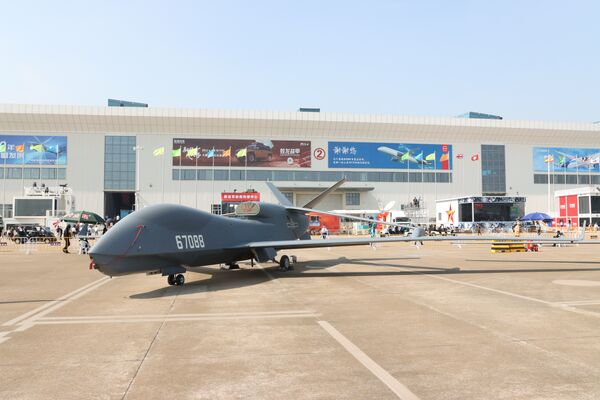

China's Guizhou WZ-7 Xianglong (Soaring Dragon) UAV is designed for ISR, BDA, and relay operations. The PLA also uses the type for close-in photography and identification of foreign naval vessels. (Janes/Sam Wise)
The Chinese People's Liberation Army (PLA) has shown for the first time that the maritime operations of high-altitude long endurance (HALE) unmanned aerial vehicles (UAVs) to identify and monitor foreign warships are conducted in collaboration with intelligence officers attached to air brigades.
China disclosed the real-time capability in its five-part Gong Jian (Forging Ahead) documentary on the PLA, which was aired by state-owned China Central Television (CCTV) in August.
In the documentary, UAVs such as the Guizhou WZ-7 Xianglong (Soaring Dragon) and the Aviation Industry Corporation of China (AVIC) Wing Loong-10 (WL-10, also known as Pterodactyl 10 or WZ-10) of a PLA Air Force (PLAAF) air brigade were shown conducting operations from at least two airbases. Janes has identified the airbases as Foshan, which is northwest of Hong Kong, and Suixi airbase in Guangdong province. Both airbases are within the PLA's Southern Theater Command (STC).
The video shows personnel of the UAV air brigade receiving a call from a higher authority ordering the UAVs to search for a “hostile warship” in a designated area because a Chinese reconnaissance satellite was unable to track the vessel. Intelligence personnel at the brigade's intelligence centre are then shown downloading data from the WL-10.
The downloaded data was sorted and analysed by an automatic identification system (AIS) allowing the intelligence personnel to determine that the seaborne “object” could be a foreign vessel, according to CCTV.
Go beyond the headlines - with direct links to interconnected entities
Get full access to validated equipment, military capabilities, and market insights.