South Korea deploys new surface-to-surface missile
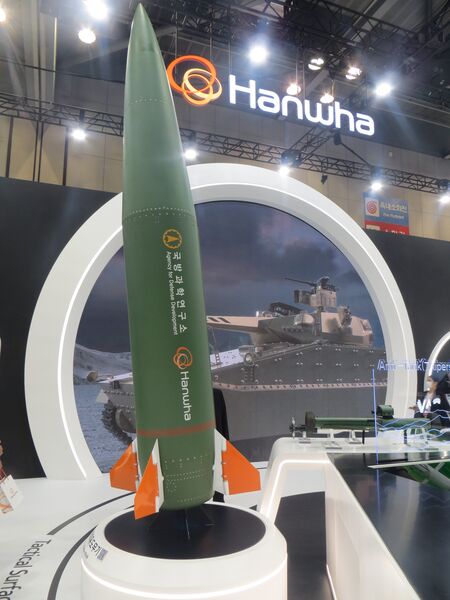

Hanwha's KTSSM system, pictured at the DX Korea 2022 show in Goyang. (Janes/Jon Grevatt)
South Korea has deployed its Korean Tactical Surface-to-Surface Missile (KTSSM) system, produced by Hanwha Aerospace, the country's Defense Acquisition Program Administration (DAPA) has announced.
KTSSM induction formally took place at a ceremony on 16 December at the Republic of Korea Armed Forces' strategic command, located close to Seoul. The system is nicknamed ‘Ure', which translates to ‘Thunder' in Korean, DAPA said. It is not known how many KTSSMs the armed forces has deployed.
DAPA said KTSSM is designed to perform rapid long-range and guided precision strikes on enemy artillery bunkers and camouflaged military installations that consist of weapons capable of threatening the Seoul metropolitan area at the early stages of war.
According to DAPA, KTSSM is a core asset in the country's kill-chain capabilities. Such capabilities are regarded as central to South Korea's three-axis defence programme, which covers air defence, pre-emptive strike, and retaliation. Kill-chain capabilities are part of the second element, which intends to destroy North Korean missile threats before they leave the country's territory.
DAPA also said an enhanced version of the KTSSM, designated KTSSM-II, is in development. The KTSSM-II is envisaged to be a vehicle-mounted system featuring increased range, penetration, survivability, and operational capacity. DAPA expects to complete the development of KTSSM-II by 2027.
The deployment follows funding worth KRW320 billion (USD217 million) approved by DAPA in November 2020 to support the mass production of at least 200 KTSSMs. The organisation conducted the KTSSM's quality certification firing trial in May 2023.
Go beyond the headlines - with direct links to interconnected entities
Get full access to validated equipment, military capabilities, and market insights.