UK, Australia to integrate battlefield sensors into US Army architecture
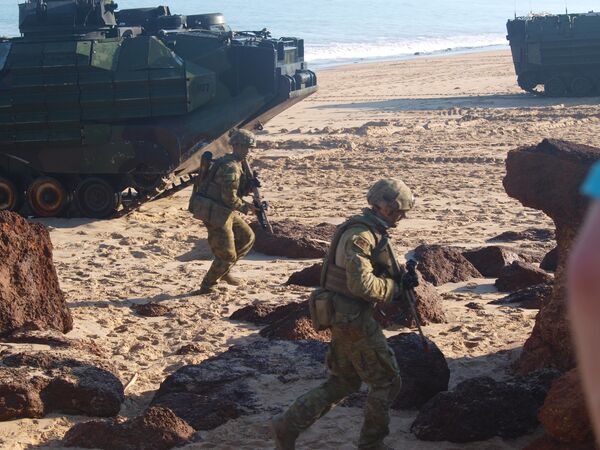

The new AUKUS partnership could increase the presence of US marines in Australia, shown here in a ‘Talisman Sabre' exercise near Darwin. (Janes/Michael Fabey)
US Army leaders with the service's intelligence, electronic warfare (EW), and sensors directorate are working with their counterparts in Australia and the United Kingdom to integrate those countries' sensor platforms into the army's networked sensor architecture.
“It is still under development right now, but we are working with them,” said Matthew Harrell regarding current progress and potential expansion of Australian and British sensor platforms being folded into the army's Integrated Sensor Architecture (ISA). Harrell is the sensor and ISA technical lead at Program Executive Office Intelligence, Electronic Warfare and Sensors (PEO IEW&S).
“We are just trying to figure out exactly what all makes the most sense” in terms of what types and numbers of Australian and British sensors should be added into the army architecture, he explained during a 3 December briefing at Fort Belvoir, Virginia.
The ongoing co-ordination effort between army officials and their counterparts in Australia and the UK, which is part of the larger trilateral security co-operative between Australia, the UK, and the US (AUKUS), is moving along parallel tracks, Harrell said. The US-UK collaboration talks have focused specifically on integration of intelligence, surveillance, and reconnaissance (ISR) sensor platforms, he said.
Go beyond the headlines - with direct links to interconnected entities
Get full access to validated equipment, military capabilities, and market insights.