UK's sensors will distinguish between ‘benign and hostile lasers' targeting satellites
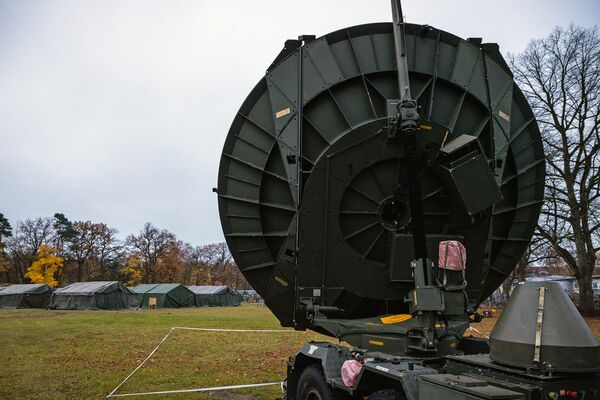

An image of the British Army's key satellite communications Reacher Large mobile X‐band satellite ground terminal from 16 November 2021. (UK MoD/Crown copyright)
The UK is investing in a new sensor technology intended to protect satellites from laser threats and able to distinguish between benign and hostile lasers, a defence source confirmed to Janes on 3 October.
“The sensor will detect any incident laser light meeting a certain threshold from the ground or from space. These incident signals may either be designed simply to accurately track and understand the satellite orbit and manoeuvres (space domain awareness) or designed to intentionally degrade, deny, or disrupt a satellite – referred to as ‘dazzling',” the defence source said.
The new sensor technology will help protect satellites “crucial to economy and security”, according to a 3 October UK Ministry of Defence (MoD) press release. It is being developed by UK Space Command (UKSC), which is a joint command of the British Armed Forces and the UK Space Agency (UKSA), according to the release.
The first allocation of funding for the project is around GBP500,000 (USD671,269), and it is part of the UKSA's Unlocking Space for Government programme, as per the release. UK companies are involved in the current stage of the project, according to the defence source.
The UK is taking “decisive steps” to increase its ability to deter threats in space and sees itself playing a “pivotal role” in strengthening European security by investing in space control capabilities, according to the source.
Go beyond the headlines - with direct links to interconnected entities
Get full access to validated equipment, military capabilities, and market insights.