US Army seeks to test launched effect with 1,000 mile range
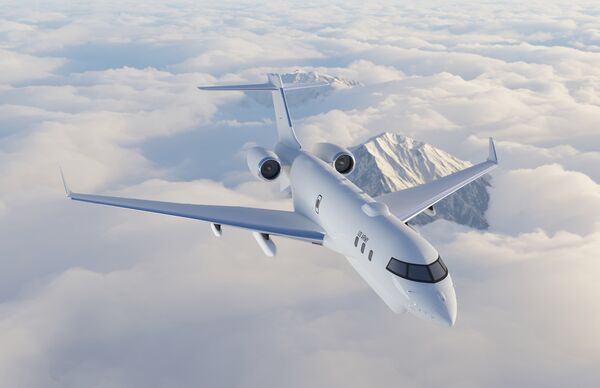

A US Army artist's conception of HADES. Note the pylons under either wing, to which the ultra-long-range LE will be mounted. (US Army)
The US Army confirmed its intent to test a launched effect (LE) that can fly over 1,000 miles later in 2025, the service told Janes on 27 May. The confirmation adds detail to an 8 January request for information (RFI) for an LE capable of launching from a Bombardier Global 6500 business jet – the same model selected for the service's ME-11B High Accuracy Detection and Exploitation System (HADES).
“HADES provides exceptional depth to army sensing as designed today,” the service said. “We are conducting a demonstration later this year to extend that sensing depth much further, not just incrementally further, but dramatically further. This dramatic increase will provide army and joint [force] commanders new options for creating sensing vectors against a variety of mobile and fixed targets.”
The first HADES aircraft is undergoing modification by Sierra Nevada Corporation (SNC), fitting the Bombardier Global 6500 with the Rapidly Configurable-X (RAPCON-X) electronic intelligence-gathering system. The aircraft is expected to be redelivered to the army in ME-11B standard in January 2026. In addition to two aerodynamic stabilising fins mounted beneath the aircraft's fuselage, the modification entails fittings for pylons on the inner and outer wing.
The January RFI requested information on an LE weighing up to 1,800 lb (816.5 kg) if mounted on inboard wing pylons or 600 lb (272.2 kg) if using outboard pylons; it is also meant to survive exposure to (and likely launch from) an altitude of 41,000 ft or higher and speeds of 400 kt or more. Such an LE would outweigh and likely outperform by a wide margin any of those publicly unveiled to date.
Go beyond the headlines - with direct links to interconnected entities
Get full access to validated equipment, military capabilities, and market insights.