USAF developing extended MANET capability for UAS
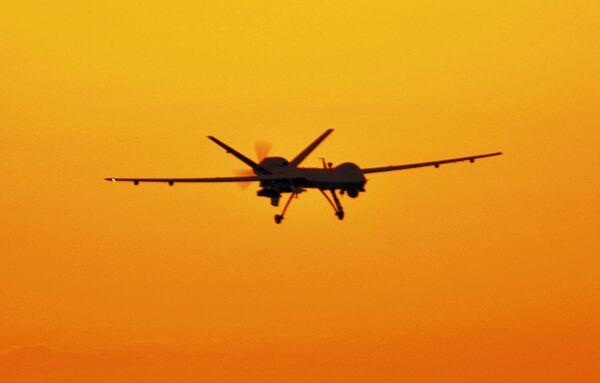

The USAF MQ-9 Reaper unmanned aerial vehicle landing at sunset. (Janes/Patrick Allen)
The US Air Force (USAF) is soliciting industry input on a new, prototype mobile ad hoc network (MANET) radio system for small unmanned aircraft systems (UASs), resulting in a potential operational range of 50 miles for air-to-air transmissions.
Current operational ranges for MANET-equipped small UAS platforms tops out at 5 miles, air service officials wrote in a US Department of Defense (DoD) Small Business Innovation Research (SBIR) solicitation. The range limitations for small UAS platforms outfitted with S-Band MANET radios is strictly related to the 5 mile connectivity limit of the radio itself.
“The capability of something like [an] air-launched small UAS exceeds this [range] by orders of magnitude,” USAF programme officials wrote in the SBIR solicitation. As a result, small UAS aircraft “are unable to exercise [at a longer] range because of this [MANET] limitation and have been mostly relegated to close-in surveillance roles where their loiter time is still useful,” service officials wrote in the SBIR solicitation.
“Greater stand-off [ranges] between a small UAS or a ground system and [the] larger airborne asset it is communicating with is greatly desired,” USAF officials wrote in the solicitation. “The operational benefits of MANET radios are enough to continue utilising them, but the government needs to develop a system to increase their range to meet emerging needs,” they added.
Previous efforts to explore extended-range MANET capabilities have been hampered by “technical issues” tied to S-Band transmission requirements.
Go beyond the headlines - with direct links to interconnected entities
Get full access to validated equipment, military capabilities, and market insights.