USMC reveals new details on UGV rocket launcher, air-launched munition
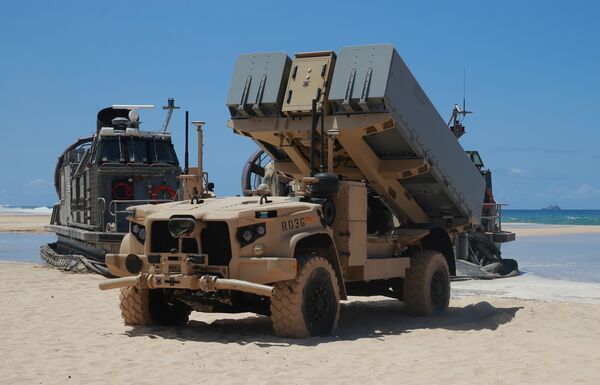

NMESIS has been deployed in the Indo-Pacific as part of large-scale joint military exercises in recent years. (US Marine Corps)
The US Marine Corps (USMC) formalised new rocket launchers and air-launched missile capabilities in its latest Force Design Update published on 23 October.
The Multiple Rocket Launch System (MRLS) Family of Munitions (MFOM) Launch Unit (MLU) was revealed by Oshkosh Defense in March 2025. At the time, it was not clear if the service planned to buy it. In the fiscal year (FY) 2026 budget request, there was not a specific procurement budget line for the system.
It is based on the already developed Remotely Operated Ground Unit for Expeditionary (ROGUE) chassis, which is essentially a tele-operated Joint Light Tactical Vehicle (JLTV). It will “provide littoral fires batteries a general support rocket capability with all current and future MFOM munitions”.
This comes as the extended range (ER) munitions in the MFOM are being reinvested in, according to USMC budget request documents for FY 2026. The end of Long Range Fires weapon system development will enable the USMC to spend more than USD500 million across FY 2025 through FY 2030, a USMC spokesperson told Janes in July. This funding will stretch across several programmes including some additional funding for Guided Multiple Launch Rocket Systems (GMLRS) ER.
ROGUE is a common launching platform for the Navy Marine Expeditionary Ship Interdiction System (NMESIS). The USMC is trying to reach 18 launchers per medium-range missile system launcher battery, but it will not meet that goal until FY 2033. The programme has faced delays due to budgeting constraints, USMC Commandant General Eric Smith said earlier this year.
Six launchers were fielded in 2023.
Go beyond the headlines - with direct links to interconnected entities
Get full access to validated equipment, military capabilities, and market insights.