WDS 2024: RoCA deploys Tron Future Tech's C-UAS
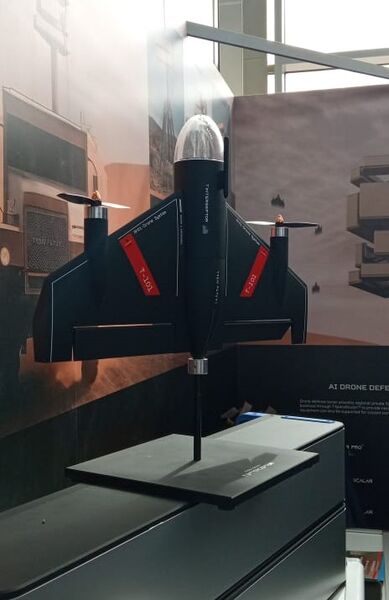

Tron Future Tech displays its C-UAS' new hard-kill component called T.Interceptor at the World Defense Show 2024 in Riyadh. (Janes/Akshara Parakala)
The Republic of China Army (RoCA) has deployed a modular counter-unmanned aircraft system (C-UAS) developed by Taiwan's Tron Future Tech, the company told Janes at the World Defense Show (WDS) 2024 held in Riyadh from 4 to 8 February.
The C-UAS, with a new hard-kill component named T.Interceptor, has been displayed at the show.
Tron Future Tech told Janes that the C-UAS delivered to the RoCA does not include the T.Interceptor. An undisclosed number of the C-UAS was delivered to the RoCA in “mid-2023” to help the service to counter incursions by Chinese unmanned aerial vehicles (UAVs). The company expects a “bigger tender” from the RoCA for the C-UAS (without the T.Interceptor) in 2024.
The C-UAS is also currently being tested by the Indian Armed Forces to respond to potential threats along India's border with China, the company said.
According to Tron Future Tech, its C-UAS includes a radio frequency (RF) detector, active electronically scanned array (AESA) radars, jammer for soft-kill measures, and the T.Interceptor to eliminate hostile UAVs.
The C-UAS' RF detector has a bandwidth coverage of 400 MHz to 6 GHz. It can detect UAVs at a range of 5 km, and uses artificial intelligence (AI) to identify their “manufacturers and models”. The C-UAS can get a 360° coverage using three detectors.
Go beyond the headlines - with direct links to interconnected entities
Get full access to validated equipment, military capabilities, and market insights.