Zodiac for British Army could be adopted by NATO's Allied Rapid Reaction Corps
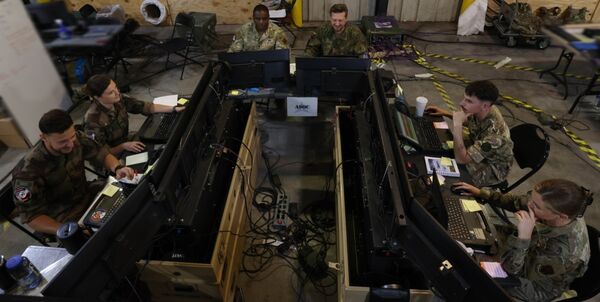

Soldiers track movements and communicate with units during the US Army-hosted ‘Warfighter Exercise 25-4' in Texas in May–June 2025, where Zodiac battlefield C2 software was tested. (US Army/Sergeant Jose Escamilla)
Zodiac software system, created for the British Army, could also be adopted by coalition forces including NATO's Allied Rapid Reaction Corps (ARRC), Roke defence director Chris Squier confirmed to Janes on 1 September.
Zodiac is a distributed middleware system that connects battlefield sensors with tactical command-and-control (C2) and effectors. The modular and open design allows it to be tailored for collaboration with NATO, Five Eyes, and other partners, according to Squier. Zodiac was developed “with multidomain operations in mind” and supports operations at all levels by using open standards to achieve this, including NATO STANAGs (standardisation agreements) and high-level interfaces, he added.
“By connecting across the Combined, Joint, Intra-Government, Inter-Agency and Multinational (CJIIM) environment, it allows allies to maximise shared investment in sensors, intelligence, and decision support. This would make it ideal as an enabler that could be adopted by coalition forces, for example, NATO's Allied Rapid Reaction Corps,” Squier told Janes .
Zodiac has been integrated with various unmanned aircraft systems (UASs) during exercises. These include the British Army's Thales Watchkeeper and AeroVironment RQ-20 Puma intelligence, surveillance, target acquisition, and reconnaissance (ISTAR) UASs, said Squier. It also enables the British Army's Tiquila UAS network for brigade and divisional operations, which reached initial operating capability (IOC) in April.
Go beyond the headlines - with direct links to interconnected entities
Get full access to validated equipment, military capabilities, and market insights.