Firehawk Aerospace eyes distributed network for 3D-printed rocket fuel
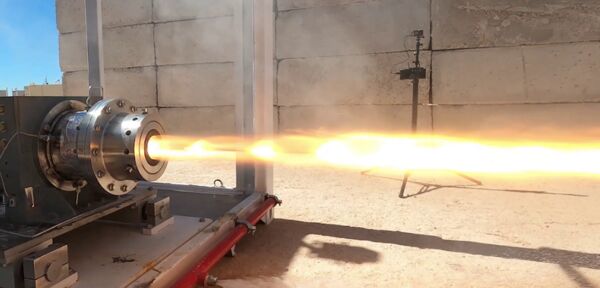

A static test firing of a Firehawk Aerospace solid rocket motor. (Firehawk Aerospace)
Firehawk Aerospace, headquartered in Addison, Texas, is bringing new technology and processes to the rocket motor market. “We really got started in early 2020, late 2019”, with a vision for 3D printing rocket fuel, Will Edwards, co-founder and CEO of Firehawk Aerospace, told Janes on 18 April. “We got our start by building these hybrid rocket engines, which are half-solid, half-liquid” fuel, he said, explaining that these depend on nitrous oxide, which reacts with the fuel, enabling “a lot of unique capabilities”.
“We learnt how to produce rocket propellant out of this material we were using” with the “oxidiser, the energetic, actually mixed into it. We found a way to essentially rapidly 3D reproduce this propellant, where it takes us about three to six hours, when traditional cast-and-cure methods take about 15–60 days”, Edwards said.
The binder for solid rocket propellant is usually a thermoset polymer called hydroxyl-terminated polybutadiene (HTPB). “We are utilising thermoplastics,” he said.
“With our thermoplastic material, we make that feedstock”, which is ingested by the 3D printer, heated, and extruded in a “more liquefied shape, and it solidifies almost immediately. We're protecting that ammonium perchlorate (AP) from decomposing due to the heat. We found a way to protect the AP from reacting so it doesn't blow up a print”, he noted, adding that “we've never blown up a printer or an extruder”.
Go beyond the headlines - with direct links to interconnected entities
Get full access to validated equipment, military capabilities, and market insights.