Leonardo DRS, Axon Vision team up on C-UAS capability
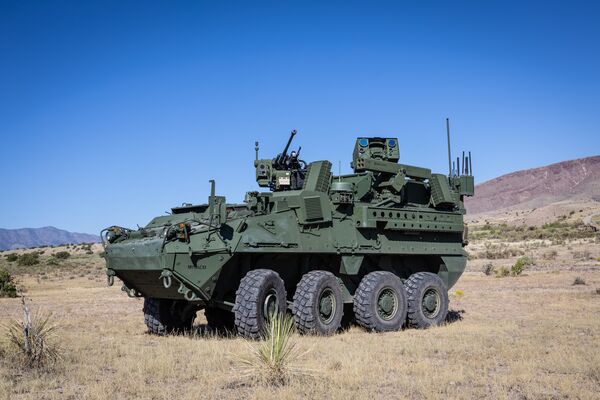

A US Army Stryker performs a demonstration for the service taking down unmanned aircraft systems. (Leonardo DRS)
Leonardo DRS has teamed up with Israel-based Axon Vision to develop integrated, artificial intelligence (AI)-enabled, counter-unmanned aircraft system (C-UAS) capabilities for US armed forces.
Under the terms of the deal finalised in January, Axon Vision's C-UASs will be integrated into several “major battle platforms” built by Leonardo DRS, according to Ori Naor, Axon Vision's vice-president for marketing and business development.
The threat of UASs that are smaller, more manoeuvrable, and cheaper to develop compared with legacy systems has quickly become “one of the most prominent emerging threats we can see across battlefields all over the world”, Naor told Janes during a 20 January interview.
Specifically, the inherent speed and manoeuvrability of these newer unmanned systems, “they are able to be very clandestine until they get to the point where friendly forces' defences are able to act”, he explained. The AI-enabled software at the heart of the company's C-UAS capability “was designed and capable of handling this type of emerging threat”, Naor noted.
The deal between Leonardo DRS and Axon Vision comes as the US Army is expanding efforts to bolster its C-UAS capabilities through fixed and expeditionary weapon systems. The capability surge comes as service leaders continue to flesh out its nine C-UAS batteries and disseminate overall C-UAS capability, tactics, techniques, and procedures to all of its formations.
Army-led efforts come roughly a year after the Pentagon issued its own department-wide C-UAS strategy. Details of the classified strategy have been kept under wraps since its release in December 2024.
Go beyond the headlines - with direct links to interconnected entities
Get full access to validated equipment, military capabilities, and market insights.