Advanced Navigation demonstrates laser velocity sensor fused with Boreas D90 fibre-optic gyroscope
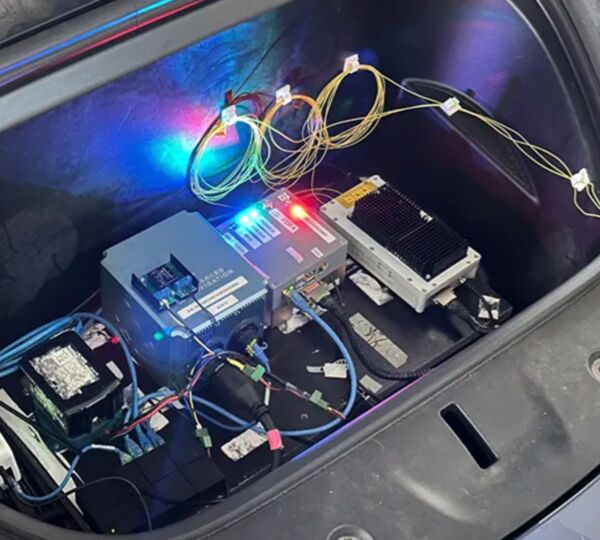

Boreas D90 INS integrated with LVS in front of the Tesla Model Y. (Advanced Navigation)
Australian engineering company Advanced Navigation has demonstrated its laser velocity sensor (LVS) fused with Boreas D90 fibre-optic gyroscope (FOG) inertial navigation system (INS), the company announced on 21 May.
The navigation system is built for global navigation satellite services (GNSS)-denied and contested environments, according to the company.
A pre-production LVS was integrated with a Boreas D90 INS and installed in a Tesla Model Y car for a series of seven trials. These involved drives around Canberra, Australia. The average error per distance (EPD) travelled using just the INS was 0.053% compared with a GNSS reference.
For the ground tests, the LVS was connected to the Boreas D90 via ethernet. All navigation data were logged on the Boreas D90 and the system was powered using a single 18 V battery.
The LVS was also tested on a fixed-wing aircraft with a final EPD travelled of 0.045% over the course of a 545 km flight.
On 30 March Advanced Navigation published a White Paper titled Laser Velocity Sensor (LVS): A High-Accuracy Velocity Aid for GNSS-Denied Navigation on its website. The paper goes into greater detail on the science behind the technology and the test results.
One of the tests included a 23 km drive, with the EPD travelled being 0.02% and a final error of 4.6 m. The EPD was used to calculate the shift in position estimates, which are the result of small sensor errors. During a 19.2 km drive, the EPD was 0.018% with a final error of 3.5 m.
Go beyond the headlines - with direct links to interconnected entities
Get full access to validated equipment, military capabilities, and market insights.