British Army looks to re-establish Corps level of command, rehearses NATO plans
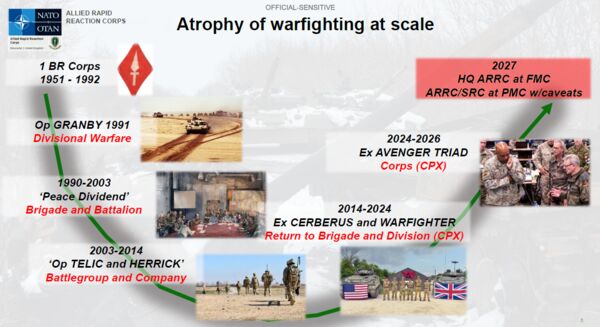

Graphic illustrating the decline and renewal of the British Army's ability to conduct warfighting at scale. (HQ ARRC)
The British Army is re-establishing its ability to conduct operations at Corps level, which has atrophied over the past thirty-five years, and is updating its headquarters (HQ) organisation and procedures to achieve this.
Speaking at the Omega Joint Military Training and Simulation (JMTS) conference held in Bristol in February, Major General Neil Grant, chief of staff of the UK-led Allied Rapid Reaction Corps (ARRC), said that this effort is in response to the threat from Russia and the “demand signal” from NATO, describing the former as “multifaceted, complex and multi-generational” which included a “very effective recce-strike complex”. NATO has designated the ARRC a strategic reserve corps (SRC) within its new regional plans.
He said that the British Army “used to know how to [conduct warfighting at scale] and we were pretty good at it”, when I (BR) Corps was in Germany and regularly practised the corps level of warfare. But the last time the army had operated at divisional (div) level had been in Operation Granby in 1991, and since then a combination of the focus on counter insurgency operations, and a shrinking army, had meant that by 2014 the unit of measure had contracted to battlegroup and company.
Maj Gen Grant said that by 2024 this was returning to brigade/div level through participation in command post exercises (CPX) such as Cerberus and the US-led Warfighter series. Following the 2022 invasion of Ukraine and new NATO requirements the corps level was required. He said that the ARRC HQ had participated in the US-led Avenger Triad (AT) 24 CPX and “had a fairly bruising experience and learnt an enormous amount”.
Go beyond the headlines - with direct links to interconnected entities
Get full access to validated equipment, military capabilities, and market insights.