Feature: NATO moves to enhance wet gap crossing capability
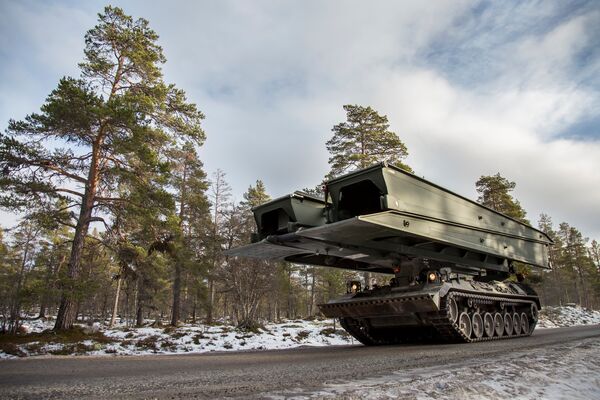

The Biber AVLB is being introduced into service with the Armed Forces of Ukraine to provide much needed gap-crossing capability. (US Army)
The UK Ministry of Defence's (MoD's) Defence Intelligence briefing posted on X (formerly Twitter) on 13 June 2022 addressed the battle around Sieverodonetsk. It said, “Over the coming months, river crossing operations are likely to be amongst the most important determining factors in the course of the war.”
Analysing the Russian front line at the time, the MoD said that to achieve success in its Donbas offensive, Russia “is either going to have to complete ambitious flanking actions, or conduct assault river crossings”. However, it added that Ukrainian forces have “often managed to demolish bridges before they withdraw” and that Russia “has struggled to put in place the complex co-ordination necessary to conduct successful, large-scale river crossings under fire”.
This was evident from the early days of the invasion after 24 February 2022 when Ukrainian forces destroyed bridges on the highway approaches to Kyiv to prevent the Russian army from advancing and taking the capital. In September 2022 during the Ukrainian counter-offensive, Russian units were forced to retreat from Kherson and this time successfully used their bridging systems to cross the Dnipro River allowing its army to pull back with minimal losses. The main bridge into Kherson, the Antonivskiy bridge, collapsed in November though it is not clear who was responsible.
Go beyond the headlines - with direct links to interconnected entities
Get full access to validated equipment, military capabilities, and market insights.