Special Report: UK's Light Mobility Vehicle programme hopes to see contract award within months
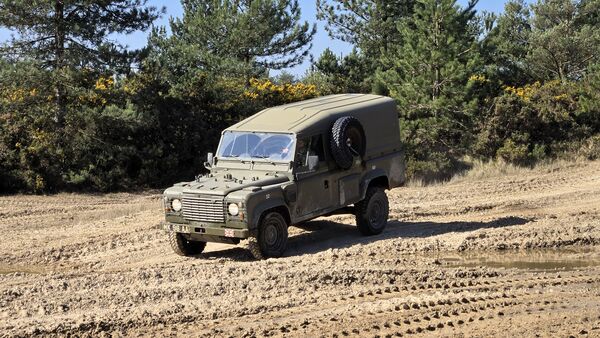

Variants of the Land Rover marque have been in continuous service with the British armed forced since the Series I entered service in 1949. (Janes/Christopher Petrov)
A ceremony was held at the British Army's Bovington Camp on 19 March to mark the beginning of the end of the Land Rover's decades-long service across the three branches of the UK's armed forces.
In light of the planned out-of-service date of 2030, the event also included the attendance of several candidate platforms competing to replace the Land Rover and Pinzgauer fleets under the Light Mobility Vehicle (LMV) requirement.
Vehicle requirements
The Light Mobility Vehicle (LMV) requirement constitutes a specific pipeline within the UK Ministry of Defence's (MoD's) broader Land Mobility Programme (LMP), a multi-pipeline initiative intended to reinvigorate the British Army's ageing light and medium vehicle fleets, and answer other light vehicle needs in the Royal Air Force and Royal Navy.
The LMP aims to replace more than 11,000 vehicles across multiple categories and sub-types that are approaching their out-of-service dates and are increasingly affected by obsolescence-related issues. A secondary objective is to rationalise the current varied vehicle fleet into a smaller number of common base vehicles, thereby reducing long-term support complexity and cost.
The programme structure has undergone recent revisions. Notably, the previously defined ‘medium' mobility category has been removed and replaced by a Heavy Protected Mobility requirement, specifying a platform with a gross vehicle weight (GVW) of approximately 20-30 tonnes.
Go beyond the headlines - with direct links to interconnected entities
Get full access to validated equipment, military capabilities, and market insights.