BAE Systems' Herne XLAUV completes first in-water demonstrations
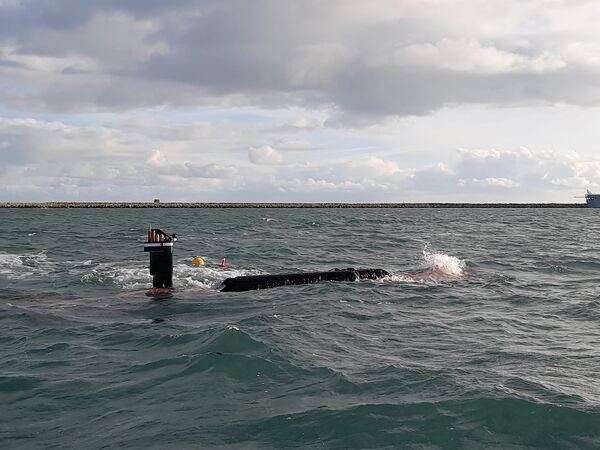

The Herne demonstrator uses a baseline platform provided by Cellula Robotics, which has been enhanced to deliver a fully autonomous militarised and configurable capability. (Janes/Kate Tringham)
BAE Systems, in partnership with Canadian marine technology company Cellula Robotics, has successfully completed the first in-water trials and capability demonstration of its Herne extra-large autonomous underwater vehicle (XLAUV).
The trials and demonstrations, held over two weeks from 11 November, were conducted at a facility on the south coast of England in front of invited observers that included representatives from 10 international navies.
BAE Systems said the aim of the demonstration was to showcase the company's advanced autonomous capabilities in an intelligence, surveillance, and reconnaissance (ISR) scenario. During the trials, Herne conducted a pre-programmed ISR mission powered by Nautomate, the company's platform-agnostic autonomous military control system.
BAE Systems joined forces with Cellula Robotics in September 2023 to fast-track the development of a militarised version of the Canadian company's Solus-XR platform that could be used to test the Nautomate ‘brain' of BAE's concept for an XLAUV.
Briefing media on 22 November, Nick Martin, project manager for Herne, said the collaboration resulted in a “whiteboard to water” capability in just 11 months – demonstrating the pace, capability, and system ecosystem that is possible with Herne.
Go beyond the headlines - with direct links to interconnected entities
Get full access to validated equipment, military capabilities, and market insights.