Dutch-led exercise illustrates MCM/CUI overlap in underwater warfare
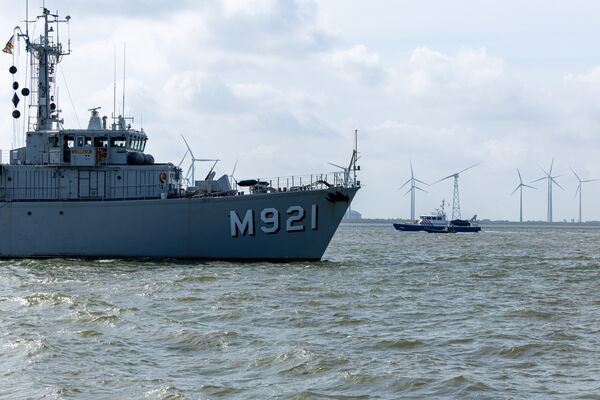

The Belgian Navy minehunter BNS Lobelia patrols off a CUI site in the North Sea during Exercise ‘Sandy Coast 2025', alongside maritime agency vessels. (NDL MoD)
A multinational exercise in the North Sea has illustrated the operational and capability overlap between mine countermeasures (MCM) operations and critical undersea infrastructure (CUI) protection, and how layered, multidomain surveillance is crucial for CUI security.
‘Sandy Coast 2025' – led by the Royal Netherlands Navy (RNLN), with the Belgian and Estonian navies participating – was the latest iteration of an annual exercise focused on clearing mines and other explosives in MCM and harbour protection tasking in the North Sea. This September CUI security and threat response were added for the first time.
“We are seeing increased military threats, with sabotage of critical infrastructure, both in the North Sea and the Baltic Sea, and closer to home,” Commander Peter Baars, an RNLN officer and commander of the exercise task group, told Janes on 3 September. “The Ministry of Defence is deploying patrol capacity to gain a better understanding of activities taking place in the North Sea. These capabilities will be tested and improved during ‘Sandy Coast'.”
Anti-submarine warfare (ASW) and MCM have traditionally been the two core tasks for NATO navies. With the recent emergence of threats to CUI, notably for NATO in the Baltic and North seas, NATO navies are now bracketing these three tasks together in what they call ‘underwater warfare'.
“The main overlap between MCM and CUI is finding an anomaly on the seabed,” Cdr Baars said. For ‘Sandy Coast', he added, “To be able to train in a challenging area, with different taskings and systems, enhances the knowledge of how to achieve the best results on both MCM and CUI.”
Go beyond the headlines - with direct links to interconnected entities
Get full access to validated equipment, military capabilities, and market insights.