Feature: UK's Oshen creating fleet of small, persistent maritime early warning USVs
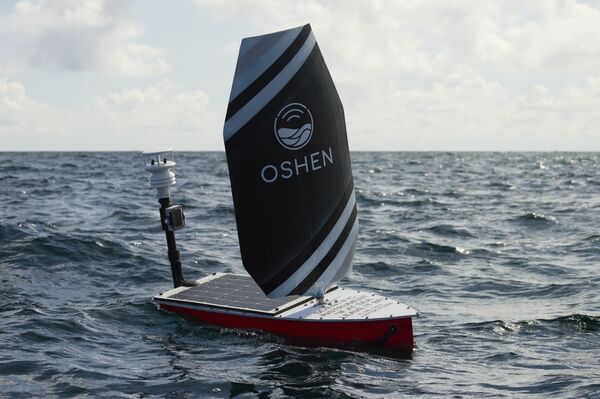

A C-Star USV during trials at sea. (Oshen)
The CEO of UK unmanned surface vehicle (USV) firm Oshen, working with the UK Ministry of Defence (MoD) on creating mass dispersed intelligence, surveillance, and reconnaissance (ISR) maritime networks, has told Janes she views their system as durable in the face of attack.
Speaking to Janes in November, Anahita Laverack, CEO of Plymouth-based Oshen, said their 1 m-long C-Star USVs were designed to be strung out in ISR gathering patterns across hundreds of miles of sea.
Persistent constellation
The plan is both simple sounding and ambitious. Oshen wants to be able to field 1,000 C-Star USVs in vast lines of maritime pickets, conducting wide area surveillance above and below the waves, with each vehicle at sea for months at a time.
On 28 September, Oshen proved parts of its concept with a C-Star becoming the first USV to capture and transmit data from inside a category 5 hurricane, Humberto, as part of research with the US National Oceanic and Atmospheric Administration (NOAA).
In its defence work the C-Stars use passive acoustic sensors for anti-submarine warfare (ASW), and electro-optic/infrared (EO/IR) sensors for visual surveillance above the waterline.
Laverack said threats to Euro-Atlantic maritime areas from actors including Russia have increased since 2023, and Oshen's production rates could come in useful.
“It takes a lot of time to build ships, even medium-sized ships. It takes around five years, even if you try really hard to build these ships, whereas this stuff [C-Stars], it's more like a DJI drone. Think of it as like, we want to ‘McDonaldsise' the process. A 19-year-old can walk in and within 30 minutes they're making the subsystems and bashing them out,” Laverack added.
Go beyond the headlines - with direct links to interconnected entities
Get full access to validated equipment, military capabilities, and market insights.