MADEX 2025: Hanwha positions Frigate 4000 for Thai navy requirements
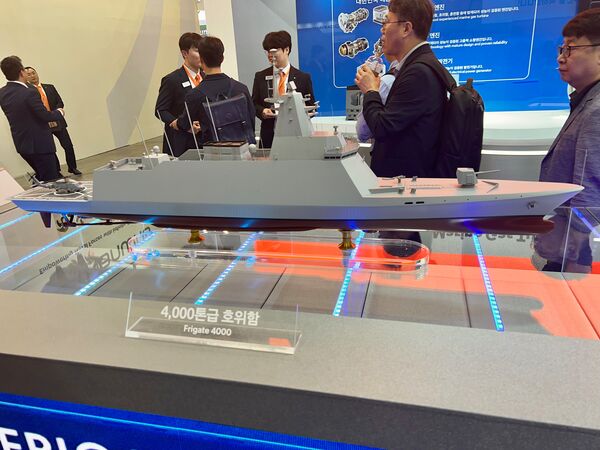

A model of Hanwha Ocean's Frigate 4000 on display at MADEX 2025. (Janes/Ridzwan Rahmat)
South Korean shipbuilder Hanwha Ocean has introduced a new counter-drone-optimised product known as the Frigate 4000 and is positioning it in anticipation of the Royal Thai Navy's (RTN's) upcoming requirements.
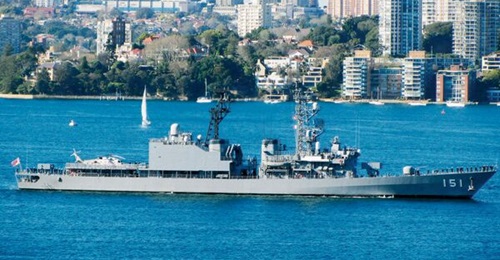
The RTN operates a sole Bhumibol Adulyadej (DW3000)-class frigate, which is derived from Batch I of the Republic of Korea Navy's Incheon (FFX-1) class.
It was launched by Hanwha Ocean's predecessor Daewoo Shipbuilding and Marine Engineering (DSME) in January 2017 and commissioned by the RTN in December 2018.
Speaking to Janes at MADEX 2025 in Busan, a representative from Hanwha Ocean's Naval Ship Global Marketing Team 1 described the Frigate 4000 as a more advanced version of the Bhumibol Adulyadej-class frigate.
The Frigate 4000 displaces about 4,000 tonnes at full load and it has an overall length of 124 m, a beam of 14.4 m, and a depth of 4.3 m.
This makes it slightly larger than HTMS Bhumibol Adulyadej, which displaces about 3,700 tonnes at full load with an overall length of 123 m.
Driven by diesel engines in a combined diesel-and-diesel (CODAD) configuration, the Frigate 4000 will have a top speed of 27 kt.
Where it differs from the older frigate is its weapon systems, which have been designed to tackle the evolving threat landscape, Kim said.
In particular, the Frigate 4000 is designed for a directed energy weapon (DEW) to be placed in the forward section. This would defend the warship against threats such as hostile unmanned aerial vehicles (UAVs).
This weapon system is located just behind a 16-cell vertical launching system (VLS), which can deploy a mix of anti-air and anti-surface missiles. Bhumibol Adulyadej
Go beyond the headlines - with direct links to interconnected entities
Get full access to validated equipment, military capabilities, and market insights.