MBDA set to move forward with surface-launched Sea Venom
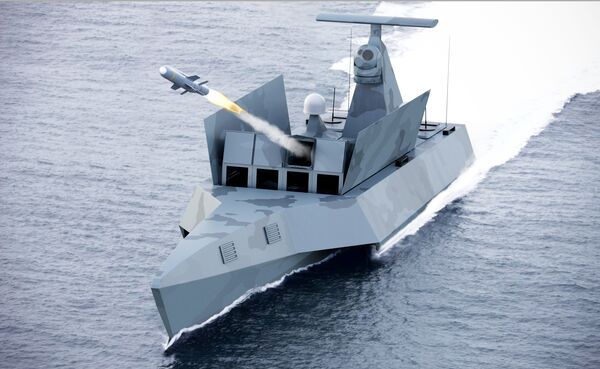

Computer-generated imagery of the surface-launched Sea Venom being fired from a USV platform. (MBDA)
MBDA is poised to roll out a surface-launched variant of its Sea Venom lightweight anti-ship missile system to address evolving market needs for a precision effector able to prosecute maritime targets in congested littoral environments.
Briefing Janes on 31 July, MBDA officials said the company had started to engage with potential customers on a canistered configuration suitable for fast patrol boats, unmanned surface vehicles (USVs), and mobile coastal batteries. The move comes as the UK Royal Navy (RN) starts to field production-standard Sea Venom missiles on its Wildcat HMA2 maritime helicopters.
Developed by MBDA to meet the needs of the UK's Future Anti-Surface Guided Weapon (Heavy) – FASGW(H) – requirement, and France's now-shelved Anti-Navire Léger programme, Sea Venom is a 110 kg-class high-subsonic missile carrying a 30 kg semi-armour-piercing blast/fragmentation insensitive munition (IM) warhead. Powered by a boost/sustain propulsion package – a fixed-aft boost motor and a mid-body rocket sustainer – the missile can fly a variety of different flight profiles, including sea-skimming, and is credited with a maximum range of up to 30 km.
Guidance uses an imaging infrared seeker, aided by a two-way datalink for operator-in-the-loop control. While Sea Venom is capable of flying a fully autonomous ‘fire-and-forget' profile, operator-in-the-loop control enables capabilities such as in-flight retargeting, aim-point correction/refinement, and safe abort.
Go beyond the headlines - with direct links to interconnected entities
Get full access to validated equipment, military capabilities, and market insights.