NATO Task Force X Baltic takes new steps in countering CUI risks
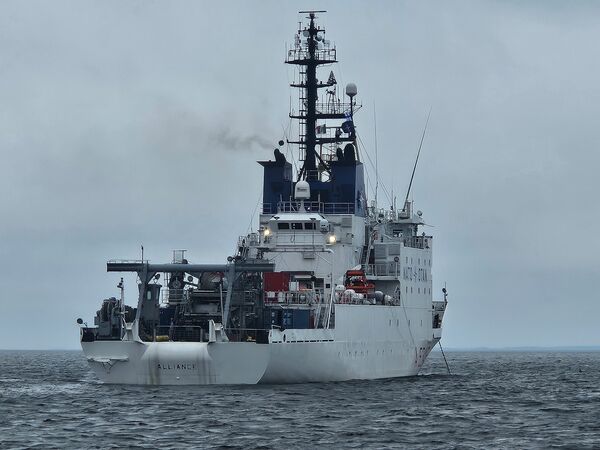

The NATO Research Vessel Alliance , which is deployed on NATO's Task Force X Baltic experimentation activity, has been supporting activity trials by acting as a rogue ship moving anomalously over seabed critical infrastructure nodes. (Dr Lee Willett)
NATO's Task Force X Baltic experimentation activity – underway across the Baltic/North seas region, and trialling technologies including uncrewed vessels and underwater sensors in building maritime situational awareness (MSA) – has demonstrated technology achievements in countering risks to critical undersea infrastructure (CUI).
These achievements include integrating sensors and architecture to monitor irregular ship movements near CUI sites, and detecting the sound of a ship's anchor being dropped on the seabed.
These requirements reflect responses to CUI disruptions such as those that occurred in the Baltic Sea between October 2023 and December 2024, when ‘shadow fleet' ships allegedly dragged their anchors across CUI sites.
The study work, being conducted by NATO's Centre for Maritime Research and Experimentation (CMRE), is focusing initially on surveilling ship movements and understanding the sound of an anchor being dropped from the surface onto the seabed. Next, the study will assess the sound of the anchor being dragged.
Work is under way onboard the NATO Research Vessel Alliance , which is deployed to support Task Force X Baltic. Alliance has acted as a suspicious vessel around CUI sites by moving anomalously compared to usual shipping patterns, before conducting anchor drops. Iron ballast moorings are used as a proxy anchor, bringing acoustic properties simulating the sound of an anchor dropping and hitting the seabed.
Various autonomous seabed sensors were used to successfully detect Alliance's
Go beyond the headlines - with direct links to interconnected entities
Get full access to validated equipment, military capabilities, and market insights.