Radar and tactics modifications help USN forces counter Houthi unmanned threats
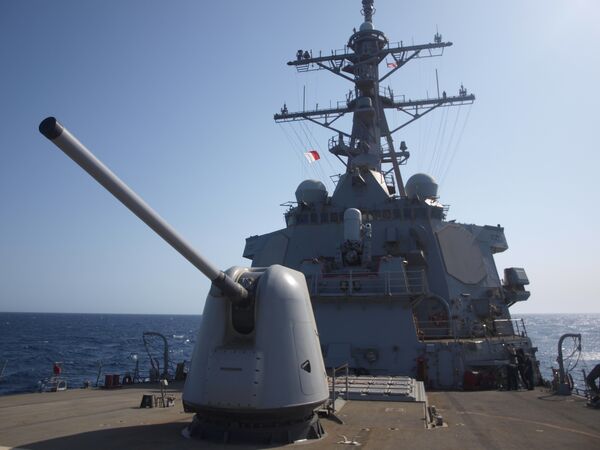

Tweaks in SPY radar equipment like that on USS Laboon, pictured here, help the US Navy counter unmanned threats in the Red Sea. (Janes/Michael Fabey)
Tweaks in ship SPY radars and aircraft active electronically scanned array (AESA) radars, combined with changes in tactics, techniques, and procedures (TTPs), have helped US Navy (USN) forces counter Houthi unmanned threats in the Red Sea region, USN officials told Janes.
“We’ve used different TTPs and some radar optimisation,” Captain Marvin Scott, commander of the air group (CAG) aboard aircraft carrier USS Dwight D Eisenhower (CVN 69), said during an interview on 12 June aboard the ship in the Red Sea.
Radar modes were better optimised for detection, he said. Looking to use aircraft more often to counter the unmanned aerial vehicle (UAV) threats, USN officials also optimised fuel for better efficiency, reacting more effectively to when the UAVs were going to be airborne, he said.
USN forces operating in the Red Sea also began to reach back to experts in the United States for advice and guidance on addressing the unmanned threats, Rear Admiral Marc Miguez, then commander, Carrier Strike Group 2, told Janes on 11 June during an interview aboard Eisenhower. Rear Adm Miguez has since left strike group command to become USN chief of legislative affairs in Washington, DC.
“We asked scientists and all people that work in the research and development community, ‘Hey, is there something we can refine?’ They’ve been able to refine our parametrics on our equipment out there. It makes it more successful in achieving non-kinetic or kinetic actions – in real time.”
Go beyond the headlines - with direct links to interconnected entities
Get full access to validated equipment, military capabilities, and market insights.