South China Sea collision points to expansion in China's ‘ram bow' tactics
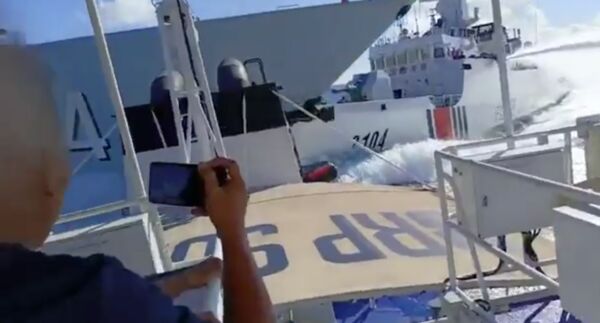

A screenshot from a video released by the Philippine Coast Guard showing a collision between the two Chinese vessels. (Philippine Coast Guard)
An 11 August collision between a People's Liberation Army Navy (PLAN) destroyer and a China Coast Guard (CCG) vessel suggests that Beijing has authorised its naval ships to employ the ‘ram bow' tactic against adversaries in the South China Sea.
This tactic centres around the usage of a ship's reinforced prow and it was previously associated only with Beijing's white hull vessels, especially those deployed by the CCG.
The collision involved the PLAN's Type 052DL (Luyang III)-class guided-missile destroyer Guilin, and the CCG vessel 3104, which has been converted from a PLAN Type 056 (Jiangdao)-class corvette.
Both Chinese ships were attempting to intercept the Philippine Coast Guard (PCG) Parola-class patrol vessel BRP Suluan, which was conducting patrols about 10.5 n miles from the disputed South China Sea feature known as the Scarborough Shoal.
According to video footage released by the PCG, vessel 3104 was in high-speed pursuit of Suluan when it executed a risky starboard manoeuvre and inadvertently placed itself in the path of the oncoming Guilin, which was trying to ram the Philippine vessel.
The resulting collision crushed the bow section of vessel 3104 and has likely rendered it unseaworthy given the extent of the damage.
From the footage, it appears that Guilin was attempting to ram Suluan head-on with its prow, which has been reinforced with a structural enhancement to withstand impact.
Guilin is a 160 m destroyer that displaces about 8,000 tonnes at full load. It is one of 31 Type 052D/052DL/052DM vessels that are in service with the PLAN.
Suluan has an overall length of about 44 m and displaces about 280 tonnes at full load. Suluan
Go beyond the headlines - with direct links to interconnected entities
Get full access to validated equipment, military capabilities, and market insights.