Special Report: German Navy attempts hybrid MCM integration
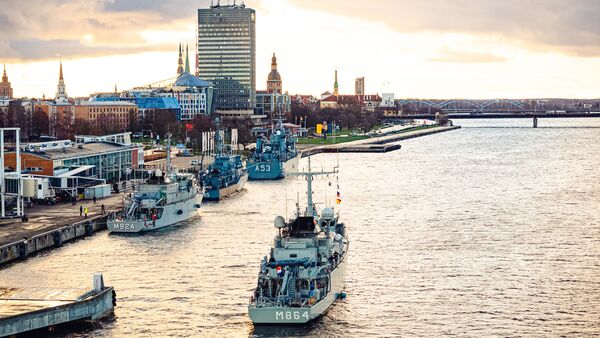

Four of the vessels from Standing NATO Mine Countermeasures Group 1 (SNMCMG1) arrived in Riga on 17 November 2025 on a port visit. (NATO Maritime Command)
The German Navy's mine countermeasures (MCM) capability is a case study in force structure changes being driven by technology.
The German Navy has been a prominent contributor to NATO MCM capability. NATO navies' steady introduction of maritime unmanned systems (MUSs) has sought to remove operators from the minefield.
The navy's Baltic home waters are now a ‘strategic sea' – for Germany, NATO, and Russia.
Russia has been conducting asymmetric activities in Euro-Atlantic areas around NATO waters. NATO navies are increasingly investing in MUSs for things such as critical underwater infrastructure (CUI) surveillance and to support operations such as MCM.
NATO navies are trying to build hybrid force structures to help counter the hybrid threat.
“We have to transform – as required by the Chief [of Navy, Vice Admiral Jan Christian Kaack] – into a hybrid navy. We must have the right mix of manned and unmanned systems, and manned-unmanned teaming,” Rear Admiral Dirk Gärtner, the German Navy's Plans and Policy Directorate head, told Janes in an interview in late September.
This transformation reflects NATO requirements, and is shown in the German Navy's MCM capability development, Rear Adm Gärtner said, adding that “if you see the new position of Germany in the NATO set-up – as a hub to deliver logistics to the East [across the Baltic] – then MCM is of much more national importance than before”.
In this operational context, the German Navy's task will be helping to keep sea lines of communication (SLOCs) across the North Sea, Skagerrak/Kattegat Straits, and Baltic Sea clear of mines.
Go beyond the headlines - with direct links to interconnected entities
Get full access to validated equipment, military capabilities, and market insights.