UK explores offshore support vessel options for MHC
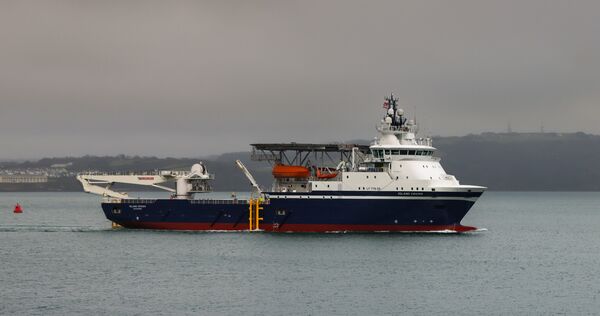

RFA Stirling Castle (ex-MV Island Crown ) was purchased from commercial interests in early 2023 to meet a requirement for an OSV to operate MHC Block 1 systems in home waters. (Crown Copyright/UK MoD)
The UK Ministry of Defence (MoD) and Royal Navy (RN) are moving forward with analyses to consider mother ship options for the next phase of the RN's Mine Hunting Capability (MHC) programme, officials have told Janes .
Current plans call for the acquisition of three offshore support vessels (OSVs) as part of the forthcoming MHC Block 2 programme. The MoD has previously purchased a commercial offshore support platform to meet its initial requirement for an OSV to support mine countermeasures (MCM) in UK waters.
The MHC programme is designed to deliver the RN a next-generation MCM capability based on autonomous ‘system of systems' packages that will be capable of executing MCM operations both in home waters and overseas. The overarching aim is to exploit advances in technology in areas such as autonomy, sensors, and advanced data processing techniques to increase the tempo of MCM; improve survey ‘product'; enhance transportability of MCM systems through ‘modularisation'; and take crews out of the mine danger area.
Planning assumptions
Current planning assumptions underpinning the RN's MHC Block 2 programme envisage a force design comprising six mission systems, plus three ‘hosting' OSVs for deployed operations. As a precursor, the MoD in early 2023 acquired the offshore vessel MV Island Crown – renamed RFA Stirling Castle – from the commercial market to serve as a UK host platform for autonomous MCM payloads previously procured through Project Wilton and MHC Block 1.
After initial trials in 2023, RFA Stirling Castle
Go beyond the headlines - with direct links to interconnected entities
Get full access to validated equipment, military capabilities, and market insights.