US expands utilisation of ‘fly-in' elements for Pacific Partnership 2024-2
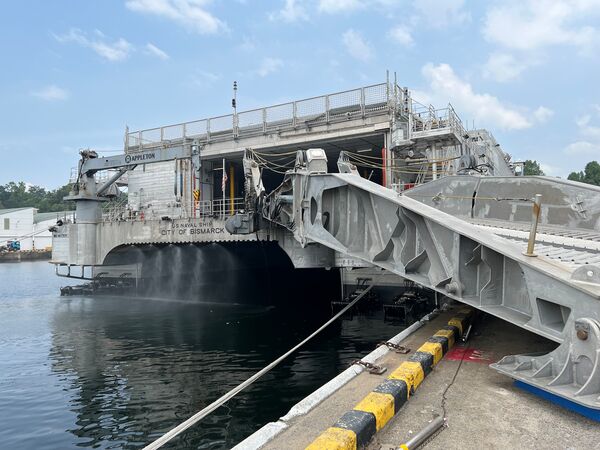

USNS City of Brunswick seen here in Singapore as part of Pacific Partnership 2024-2. (Janes/Ridzwan Rahmat)
The US Navy (USN) is expanding upon its usage of ‘fly-in' elements at the latest iteration of Pacific Partnership – the service's largest annual humanitarian assistance and disaster relief (HADR) mission in the Indo-Pacific.
Speaking to Janes onboard the expeditionary fast transport ship USNS City of Bismarck (T-EPF 14) while it was in Singapore, Commander, Logistics Group Western Pacific Rear Admiral Mark Melson described the iteration as one that would help the navy better understand the scope of aviation operations associated with HADR missions in the region.
Previous iterations of Pacific Partnership have largely involved vessels such as the hospital ship USNS Mercy and other expeditionary fast transports. City of Bismarck is one of the vessels involved in the latest iteration, which has been dubbed Pacific Partnership 2024-2.
Its sister event, Pacific Partnership 2024-1, began in October 2023 and concluded in January 2024.
Pacific Partnership 2024-2 began on 30 July at the Port of Legazpi in the Philippines, with the arrival of City of Bismarck in the southern Luzon city.
Ahead of City of Bismark 's arrival, the USN flew in around 100 personnel and various mission equipment onboard Boeing C-40 Clipper and Lockheed C-130 Hercules transport aircraft from the Paya Lebar Airbase in Singapore.
Go beyond the headlines - with direct links to interconnected entities
Get full access to validated equipment, military capabilities, and market insights.