US Task Force 66 capturing unmanned lessons learned from Ukrainian operation
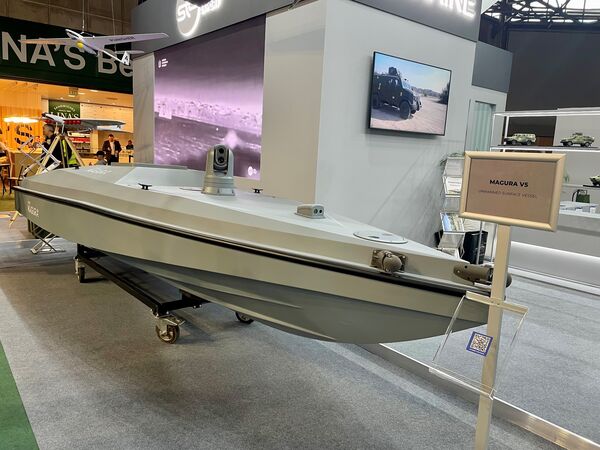
A life-size model of Ukraine's Magura V5 USV, pictured here at Eurosatory 2024; one of the unmanned platforms being used against Russian forces. (Janes/Olivia Savage)
The US Commander, Task Force (CTF) 66, the US Sixth Fleet's purpose-built all-domain task force with the mission of integrating Robotic and Autonomous Systems (RAS) into fleet operations, is looking for ways to incorporate lessons learned from Ukrainian operations, the Sixth Fleet acknowledged in a release on 17 June.
Established in 2024 to deploy and employ RAS with US Navy (USN), joint, and NATO partners, CTF 66 utilises RAS with conventional manned platforms and space-based capabilities to expand Maritime Domain Awareness (MDA), develop defence measures against adversarial use of RAS, innovate asymmetric fighting, and in the future, deliver lethal effects, if necessary, Sixth Fleet officials said.
“CTF 66's close collaboration with Ukraine provides insight into the employment of RAS in the challenging Black Sea environment against a capable and adaptive enemy,” the Sixth Fleet release said.
“Known by its nickname the ‘Black Sea Battle Lab', CTF 66 has observed Ukraine employ RAS in order to secure crucial sea lanes for continued economic activity and deny the Russian Federation Navy's use of the Black Sea to launch offensive attacks,” Sixth Fleet officials said.
“The opportunity to closely observe the cycle of action-reaction-counter-action in the Black Sea is a unique advantage that allows CTF 66 to learn from real-world conflict and adapt to the changing character of war,” Rear Admiral Michael Mattis, CTF 66 commander, said in a statement.
For more information on Ukrainian USV operations against Russian forces, please see Ukraine says Magura V5 USV downed Russian Mi-8 helicopter with adapted AAM .
Go beyond the headlines - with direct links to interconnected entities
Get full access to validated equipment, military capabilities, and market insights.