Belgium Naval & Robotics delivers first mine countermeasures toolbox
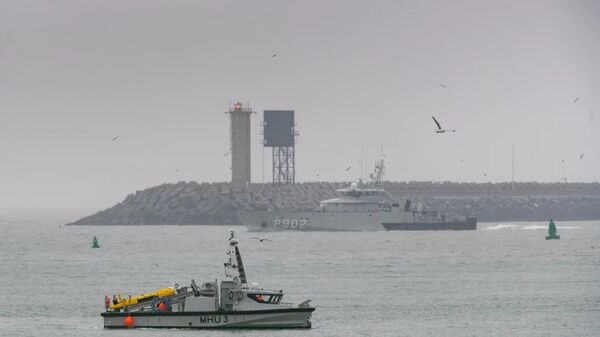

An Inspector 125 USV, part of the MCM toolbox provided by Exail as part of the Belgian-Netherlands replacement Mine Countermeasures programme. (Belgian Navy)
The Belgian-Netherlands (BE/NL) replacement Mine Countermeasures (rMCM) programme achieved a new milestone with the delivery of the first mine countermeasures (MCM) ‘toolbox'.
Announced on 2 March by rMCM prime contractor Belgium Naval & Robotics - a consortium established by Naval Group and Exail - the toolbox was handed over in Zeebrugge, Belgium. The term toolbox refers to a suite of unmanned underwater, surface, and aerial systems, together with associated mission management solutions. They are deployed from a mother ship outside the mine danger area to perform mine detection, classification, localisation, identification, and neutralisation at stand-off range.
Belgium Naval & Robotics was in May 2019 contracted by Belgian Defence for the delivery of the next generation rMCM capability based on mother ships employing a ‘toolbox' of offboard MCM systems. The 10-year contract, valued at almost EUR2 billion, covers the supply of 12 2,700-ton displacement mother ship vessels (six for each navy) plus MCM toolboxes based on systems drawn from Exail's own Unmanned MCM Integrated System (UMIS) offboard MCM suite. With the exception of the unmanned air vehicles (UAVs), all unmanned assets have been produced and assembled at Exail's facility in Ostend.
Go beyond the headlines - with direct links to interconnected entities
Get full access to validated equipment, military capabilities, and market insights.