Feature: MHC programme creates path for RN's transition to autonomy
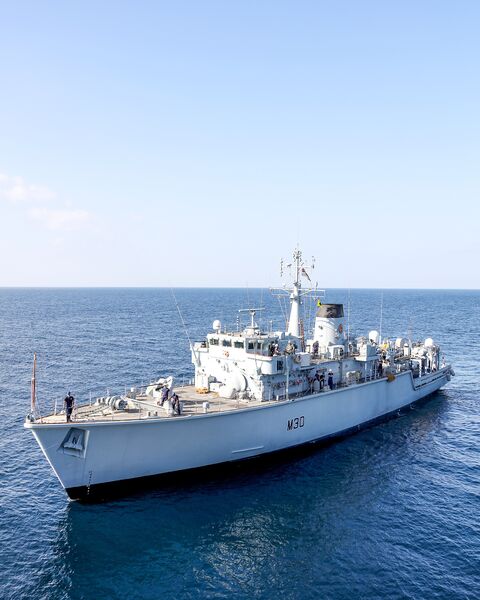

Hunt-class MCMV HMS Ledbury pictured operating in the Gulf. The MHC programme seeks to replace legacy MCMVs with a new toolbox of modular and scalable mission packages based on autonomous systems. (Royal Navy/Crown Copyright)
The UK's Strategic Defence Review (SDR) 2025, published in June, put significant emphasis on the greater employment and accelerated introduction of autonomous systems across the UK armed forces to create agility, lethality, mass, and endurance. In the specific case of the Royal Navy (RN), the SDR urged a continued transformation “in skills, equipment, and ways of operating” to include the fullest exploitation of autonomous capabilities in the undersea domain.
Mine countermeasures (MCM) are in the vanguard of this transformation. It was around 2005 that capability managers in the Ministry of Defence (MoD) drafted a capstone strategy for a next-generation MCM construct that would, over time, replace existing platform-centric capabilities with a new breed of offboard systems operating on, above, and below the waterline.
What initially became known as Future Mine Countermeasures Capability has, over time, evolved into the Mine Hunting Capability (MHC) programme. However, its key tenet has endured: replace the capabilities hosted in the Hunt-class and Sandown-class mine-countermeasures vessels (MCMVs) with a new suite – or ‘toolbox' in modern parlance – of modular and scalable mission packages leveraging innovation in vehicle autonomy, offboard sensors, and advanced data processing to deliver search, detect, identify, neutralise, and sweep capabilities from stand-off range.
Go beyond the headlines - with direct links to interconnected entities
Get full access to validated equipment, military capabilities, and market insights.