Israel using ground-based Barak air-defence system
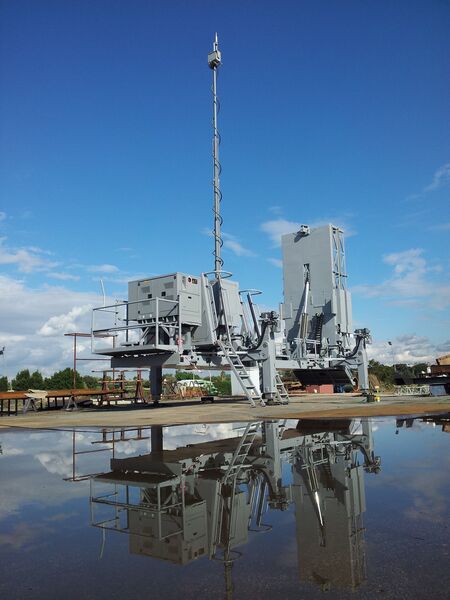

A Barak MX launcher. (Israel Aerospace Industries)
The Israel Defense Forces (IDF) revealed on 20 June that it is using the ground-based version of the Barak air-defence system.
It said the Israeli Air Force (IAF) air defence corps had used the Barak system operationally for the first time to shoot down an unmanned aerial vehicle (UAV).
The original Barak is a naval surface-to-air missile (SAM) that was developed by Israel Aerospace Industries (IAI) and fielded in the mid-1990s. IAI subsequently developed the Barak 8, which was exported to Azerbaijan with ground systems, and India as a naval SAM and with ground systems.
IAI then developed new versions of the Barak 8 with dual-pulse motors and rocket boosters to extend its range, as well as a short-range missile. The company now markets these as the SAMs for the modular Barak MX family with ranges between 15 km and 150 km. It is unclear which types are in service with the IAF.
The IDF announced on 16 June that the first successful interception had been carried out by a Barak LRAD missile launched from one of the Israeli Navy's new Sa'ar 6 corvettes. This name was used for the version with the dual-pulse motor, giving it a range of 70 km, before it was renamed the Barak LR. The Barak LR is called the Barak ER when it is fitted with a rocket booster that extends its range to 150 km.
For more information, please see Generation MX: Barak evolves to meet the new threat .
Go beyond the headlines - with direct links to interconnected entities
Get full access to validated equipment, military capabilities, and market insights.