TADTE 2025: NCSIST displays Rocket Turret Vehicle
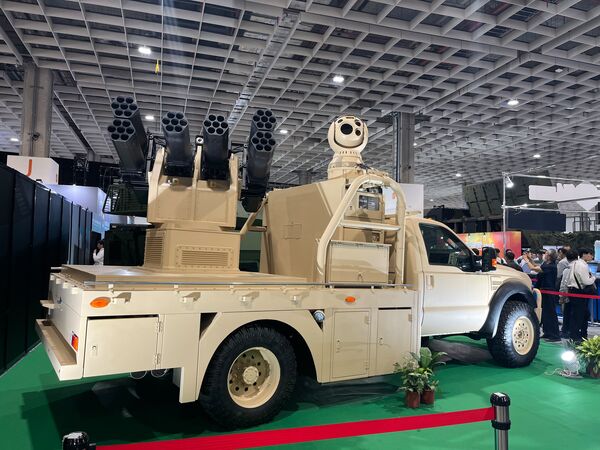

NCSIST's Rocket Turret Vehicle system. (Janes/Vishal Sengupta)
Taiwan's National Chung-Shan Institute of Science and Technology (NCSIST) displayed its 2.75 inch Rocket Turret Vehicle system at the Taipei Aerospace & Defense Technology Exhibition (TADTE) 2025 held from 18 to 20 September.
According to NCSIST, the Rocket Turret Vehicle is based on a 4×4 pickup truck, fitted with a rocket turret system at the rear and an electro-optical surveillance system at the top of the vehicle.
The surveillance system features a visible light camera, a forward-looking infrared (FLIR) camera, and a laser rangefinder (LRF), and has a range of 10 km. Once it locks onto a target, the system can automatically complete the ballistic calculation and cue the turret towards the target, effectively engaging it at a distance of 8 km, NCSIST said.
The turret has a launching rate of one rocket/1.5 seconds, an elevation of -15–50º, and a maximum rotation speed of 40º/second. NCSIST said rockets can be fired from within the vehicle or remotely from a stand-off range using a control panel console.
According to NCSIST, the Rocket Turret Vehicle was designed for the Republic of China (RoC) Coast Guard and is intended to counter both naval vessels and unmanned aerial vehicles (UAVs). A NCSIST official confirmed that the RoC Coast Guard ordered the system but did not elaborate.
For more information, please see Taiwan conducts first HIMARS drills .
Go beyond the headlines - with direct links to interconnected entities
Get full access to validated equipment, military capabilities, and market insights.