Russian infantry weapon developments in Russo-Ukrainian war
Russian Small Arms Modernisation During the Russo-Ukrainian War
Using Janes assured foundational intelligence and interconnected data and analysis, which can be integrated into your own system, you can gain situational awareness of Russia’s evolving small arms inventory, its operational feedback, and the broader implications for force modernisation during the ongoing conflict in Ukraine.
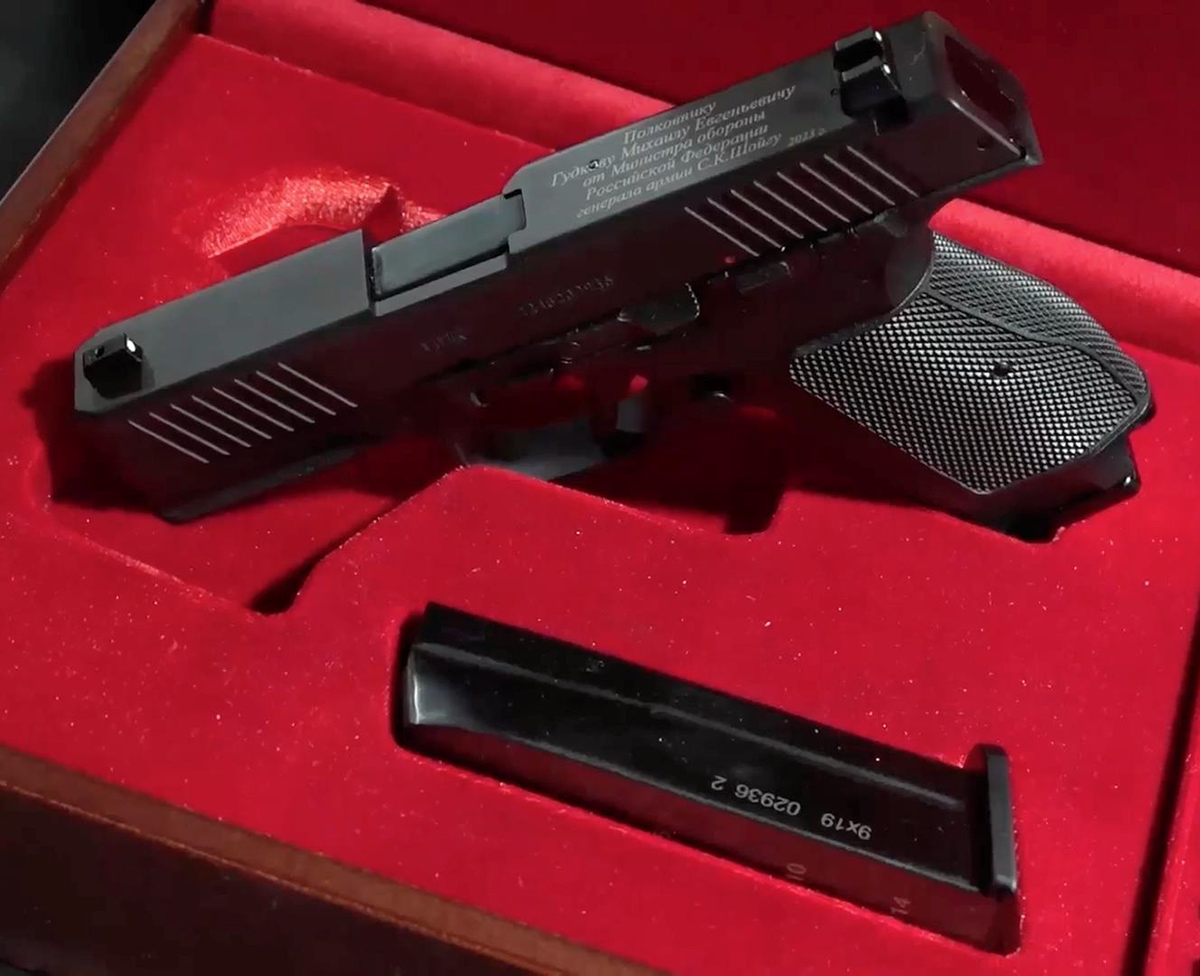 PLK awarded to the colonel of the 155th Naval Infantry Brigade. (Russian MoD/2063168)
PLK
- Issued to aircrews since the invasion
- Awarded as honorary pistol to elite units since 2023
Technical specifications:
- Cartridge: 9×19 mm
- Operation: Short-recoil
- Firing method: Striker-fired
- Feed: Detachable, double‐column box magazine
- Magazine capacity: 14 rounds
- Weight: 730 g (unloaded)
- Length: 185 mm
PLK: A Modern Sidearm for Aerospace Forces
The PLK is a compact model from the Lebedev pistol family and was introduced into service with the Russian Aerospace Forces as a sidearm for aircraft crews following the invasion of Ukraine. It replaces the APS (Stechkin), a Soviet-era selective-fire pistol chambered in 9×18 mm, which has long been out of production.
The PLK is the first striker-fired pistol to be officially adopted by the Russian military. Chambered in 9×19 mm, it supports both 7N21 and 7N31 cartridges, offering enhanced penetration. Compared to the APS, the PLK is significantly more compact, ergonomically superior, and features a modern low-bore axis design. An ancillaries rail is integrated into the forward underside of its aluminium alloy frame.
Since 2023, the PLK has also been awarded as an honorary sidearm to distinguished officers from elite units, including naval infantry troops. General feedback has been highly positive, particularly regarding its reliability and ergonomics. However, some personnel have expressed nostalgia for the APS’s selective-fire capability.
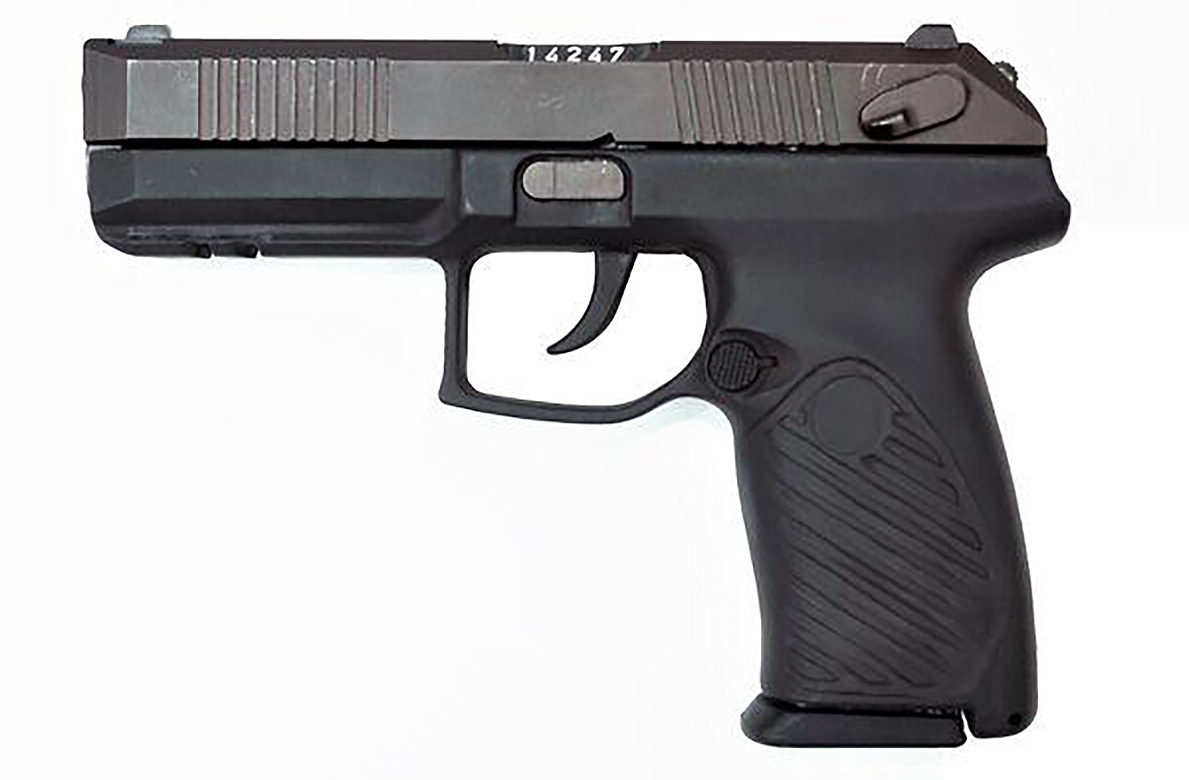
Janes/Miko Vranic/1732456
Udav: Special Forces Sidearm
The Udav pistol has also seen deployment during the Russo-Ukrainian war. Initially acquired in small numbers in 2020, it was issued to Spetsnaz and other special purpose units. Janes assesses that further deliveries have occurred since.
The Udav is a hammer-fired pistol with a polymer frame and steel slide. It features an ancillaries rail and an enlarged trigger guard for gloved use in cold environments. Chambered in 9×21 mm—a round optimised for penetrating body armour and helmets—the Udav has been used by the FSB, FSO, military intelligence (GU), and army special forces.
While the pistol is praised for its ruggedness, ambidextrous controls, and ergonomic grip, its slide-mounted safety is considered outdated and may hinder operation without grip adjustment. Additionally, the 9×21 mm ammunition remains scarce and expensive, with limited distribution of the newer 7N42 round, which offers improved accuracy and penetration over the standard 7N29.
- Developed in mid-2010s and originally intended as replacement for the PM and PYa service pistols in Russian military
- Issued in small numbers to special purpose units
- Standard 6P72 model observed in use in Ukraine
Technical specifications:
- Cartridge: 9×21 mm
- Operation: Short-recoil
- Firing method: Hammer-fired
- Feed: Detachable, double‐column box magazine
- Magazine capacity: 18 rounds
- Weight: 780 g (unloaded)
- Length: 206 mm
PP-2000: Sub-Machine Gun for Aerospace Forces
The PP-2000 sub-machine gun has been issued to Aerospace Forces crew members since the start of the invasion. It replaces the AKS-74U compact assault rifle, which ceased production in the early 1990s.
Chambered in 9×18 mm, the PP-2000 supports both 7N21 and 7N31 cartridges and is typically issued with a suppressor. While feedback has been generally positive, many users have expressed a preference for a compact weapon chambered in an intermediate cartridge, similar to the AKS-74U. The PP-2000 is widely regarded as a stopgap solution, with the AM-17 assault rifle in 5.45×39 mm potentially set to replace it in the future.
 Su-30SM crew member during target practice with PP-2000 in 2023. (Russian MoD/2063169)
Issued to aircrews since the invasion
Technical specifications:
- Cartridge: 9×19 mm
- Operation: Blowback, selective‐fire
- Feed: Detachable, double‐column box magazine
- Magazine capacity: 20 or 44 rounds
- Weight: 1.6 kg (unloaded, with empty 20 rds magazine)
- Length: 350 mm (stock folded)
AK-12: Evolution of the Standard-Issue Rifle
The AK-12 family of assault rifles has seen widespread use during the conflict. Most Russian personnel are equipped with one of the three in-service generations, with the second generation being the most common. The third generation, designated AK-12 Obrazets 2023, was first observed in operational use during the May 2024 cross-border push into Kharkiv Oblast by the newly formed Group of Troops ‘North’. Trials reportedly began in 2023.
Despite the integration of modern features such as accessory rails, the AK-12 has faced criticism over part quality, likely due to steel processing issues. As a result, many special forces operators continue to use older AK models with aftermarket or MoD-issued Obves kits.
The first two generations had issues with the upper handguard rail losing zero when mounting optics. This was addressed in the Obrazets 2023, which features a redesigned handguard. The latest model also includes an ambidextrous fire selector on the receiver and omits the two-round burst mode. A slotted combo flash hider and compensator is integrated into the muzzle to support quick suppressor attachment. Notably, rifles in Ukraine are rarely seen with the adjustable cheek piece fitted.
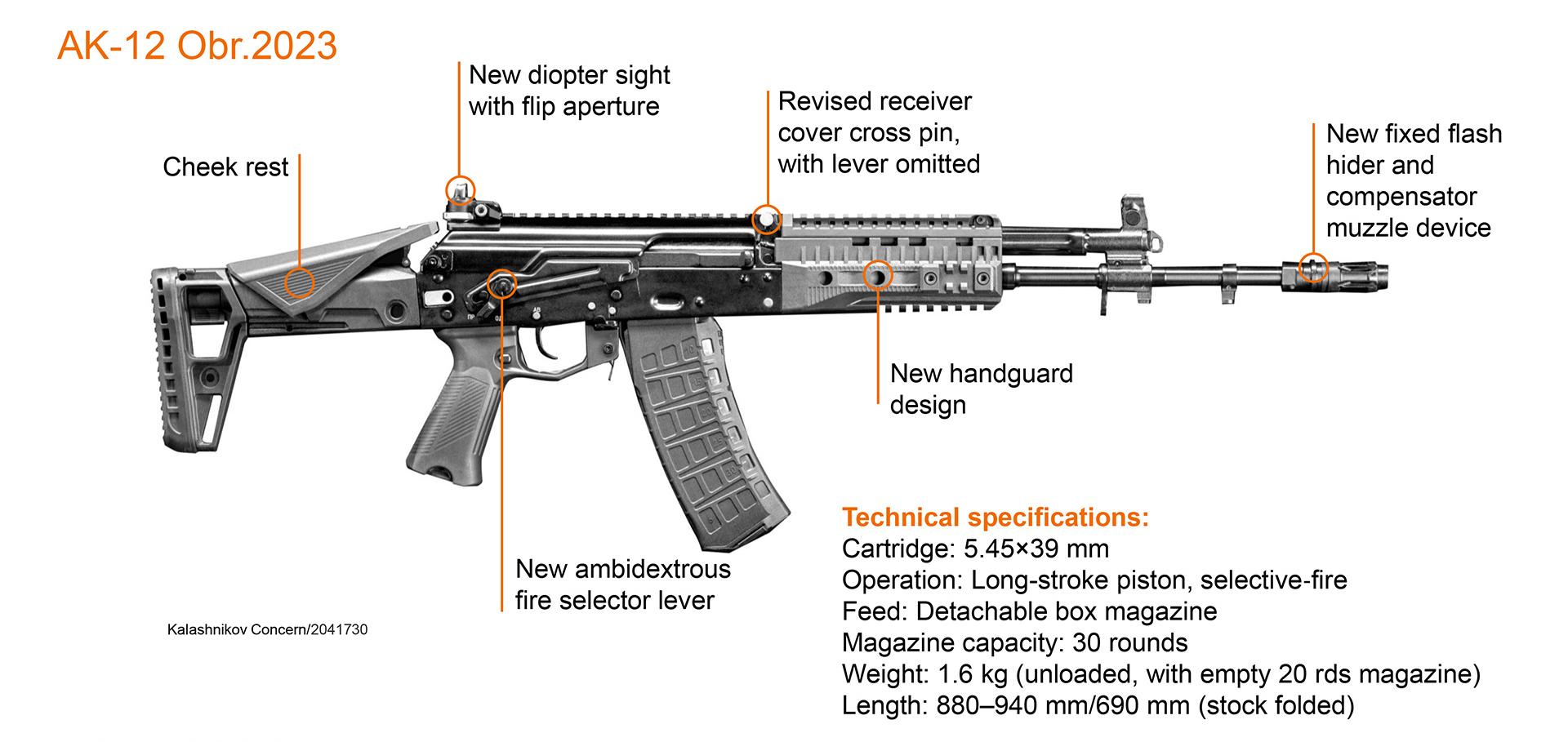
Kalashnikov Concern/2041730
Special Purpose and Experimental Small Arms in the Russo-Ukrainian War
Janes continues to monitor the deployment and operational feedback of advanced and experimental small arms used by Russian forces in Ukraine. These weapons, often issued in limited numbers to elite or specialised units, reflect ongoing efforts to modernise and diversify Russia’s infantry capabilities.
6P67: Counter-Recoil Assault Rifle for Elite Forces
The 6P67 assault rifle, featuring a complex counter-recoil gas operation system designed to reduce recoil and muzzle climb during automatic fire, was first observed in Ukraine in 2022. Janes assesses this as the rifle’s combat debut, likely in the hands of Airborne Troops Spetsnaz operatives.
While the 6P67 offers advanced performance characteristics, its intricate design and high production cost make it unsuitable for widespread distribution. It is unlikely to be adopted beyond select special purpose units for whom it was originally intended.
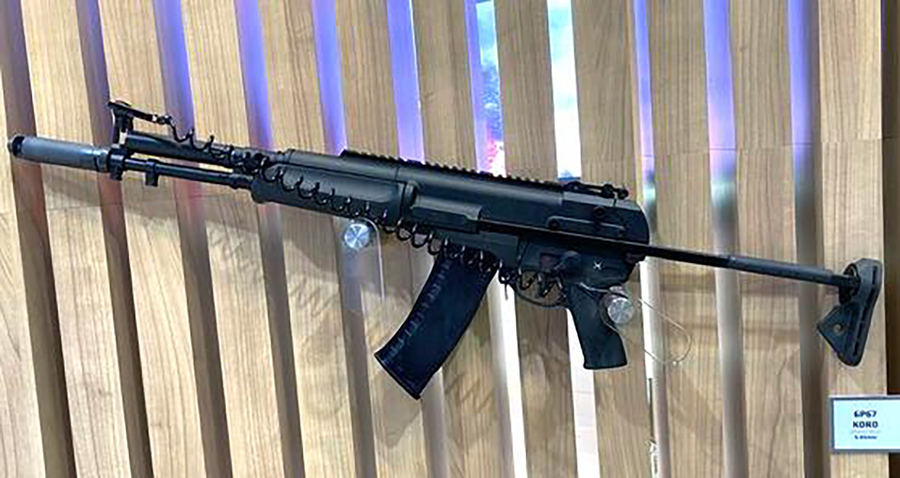 Janes/Mohammed Abu Dair/1743910
- Issued in small numbers to airborne troops in early 2020s
- First observed in operational use during the invasion of Ukraine
Technical specifications:
- Cartridge: 5.45×39 mm
- Operation: Gas, long-stroke piston, selective‐fire
- Feed: Detachable box magazine
- Magazine capacity: 30 rounds
- Weight: 3.46 kg (unloaded)
- Length: 960 mm/720 mm (stock retracted)
AMB-17: Integrally Suppressed Compact Rifle
The AMB-17, originally developed in the mid-2010s, is an integrally suppressed assault rifle chambered for the subsonic 9×39 mm cartridge. Its designation—Avtomat Malogabaritniy Besshumniy—translates to “compact suppressed assault rifle.” The weapon features a polymer lower and pivoted upper receiver with steel reinforcements.
The current iteration includes a quick attach/detach suppressor and a redesigned handguard resembling that of the AM-17 compact assault rifle. The AMB-17 is seen as a potential successor to the TsNIITochMash SR-3 Vikhr series developed in the early 1990s.
In early 2024, the AMB-17 was observed in use by an operative from the 88th Reconnaissance Assault Brigade deployed in Ukraine. Janes assesses that a small batch has been delivered for operational trials. Due to the high cost and limited availability of 9×39 mm ammunition, the AMB-17 is expected to remain restricted to reconnaissance and special purpose units and is unlikely to enter mass production.
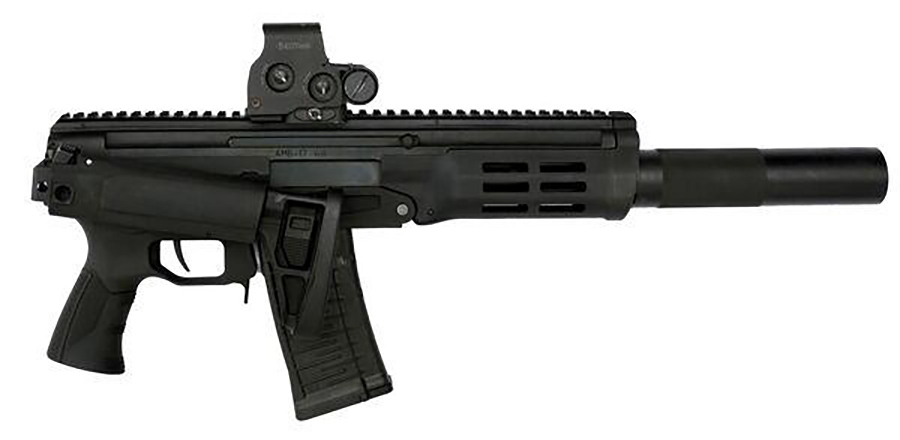 Early version of the AMB-17 rifle. (Janes/Miko Vranic/1732451)
Issued in small numbers, likely for operational trials, during the invasion of Ukraine
Technical specifications:
- Cartridge: 9×39 mm
- Operation: Gas, short-stroke piston, selective‐fire
- Feed: Detachable box magazine
- Magazine capacity: 10, 20, or 30 rounds
- Weight: 2.9 kg (unloaded)
- Length: 850 mm (with suppressor)/600 mm (with suppressor, stock folded)
ASh-12: Large-Calibre Rifle for Assault Subunits
In 2023, the Russian Ministry of Defence established organic assault subunits within many mechanised formations, tasked with breaching fortified and static defensive lines. Reports from late 2023 indicated that these units were to be equipped with ASh-12 assault rifles chambered in 12.7×55 mm.
Although Janes has not yet observed the ASh-12 in theatre, it is plausible that a small batch has been issued for trials. Originally developed for the Russian FSB in the 2000s, the ASh-12 is a selective-fire bullpup rifle designed for short-range barrier penetration using large-calibre projectiles to maximise stopping power.
The weapon supports a proprietary suppressor and a range of ancillaries, making it suitable for specialised breaching operations in urban or fortified environments.
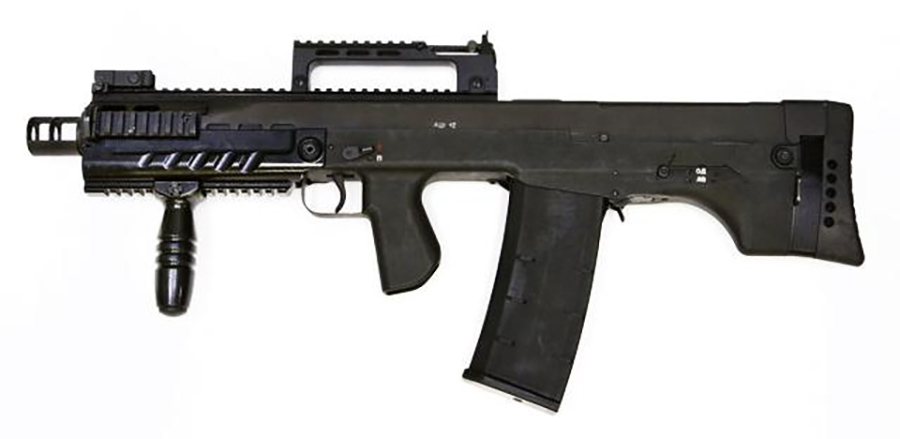 Credit: 1685143 (KBP)
Intent to equip assault units publicised in late 2023
Technical specification:
- Cartridge: 12.7×55 mm
- Operation: Gas, short-stroke piston, selective‐fire
- Feed: Detachable box magazine
- Magazine capacity: 10 or 20 rounds
- Weight: 5.2 kg (unloaded)
- Length: 675 mm
Transcript
Hello and welcome to today's online intelligence briefing. The Ukraine theatre of operations serves as a testbed for new equipment, offering an unprecedented opportunity to the Russian General Staff to test weapons against the near-peer adversaries and in a modern combat environment. The briefing will analyse Russian infantry weapon developments in the ongoing Russo-Ukrainian war. My name is Miko Vranic. I'm a lead analyst on the Military Intelligence desk at Janes. The slides from today's briefing and the audio recording are available to download from the Janes customer portal, and we encourage you all to ask questions about this presentation. To do this, please send your questions using the email address intelligence.briefings@janes.com. We shall first take a look at the in-service pistols.
The PLK is a compact model from the Lebedev pistol family range and was introduced into the Russian Aerospace Forces service as an aircraft crew sidearm after the invasion. The pistol is a replacement for the APS, more commonly known as Stechkin, a Soviet-era selective-fire pistol chambered in 9×18, which hasn't been in production for decades. The pistol represents the first striker-fired pistol to officially be adopted as a service sidearm in the Russian military. The PLK is chambered for 9×19 rounds and can use both the 7N21 and 7N31 cartridges that offer enhanced penetration. It has much smaller dimensions than the APS. It is ergonomically superior than its predecessor and is of a modern low-bore axis design. An ancillaries rail is incorporated into the forward underside of the aluminium alloy frame ahead of the trigger guard. Since around 2023 the pistol has also been awarded as an honorary sidearm to distinguished officers from elite units such as the naval infantry troops. The general feedback on the PLK has been very positive. The pistol is highly praised for its reliability and ergonomics. However, some crew members have expressed longing for the selective- fire feature of the APS. Another pistol that has made an appearance during the Russo-Ukrainian war is Udav.
A small batch was acquired by the Russian military in 2020 and was issued to special purpose or Spetsnaz units. Janes assesses that subsequent deliveries have taken place since. The Udav is a hammer-fired pistol featuring a polymer frame and steel slide. An ancillaries rail is incorporated into the forward underside of the frame ahead of the trigger guard. The trigger guard itself is substantially enlarged to allow for glove use in cold weather. The Udav is chambered for 9×21 cartridge developed by TsNIITochMash in the early 90s. The round is optimised for penetration of body armour and combat helmets and has been in use, in particular by the Federal Security Service, more commonly known as FSB, and Federal Protection Service FSO, and by the military intelligence and army special forces units to a lesser extent for the past few decades. While the pistol is reported to be rugged, has ambidextrous controls, and its polymer frame incorporates a comfortable pistol grip, its slide-mounted safety is of a somewhat dated design, as it might hinder operation by the firing hand without shifting grip. In addition, the 9×21 rounds are in scarce supply due to price and limited output, with most users reporting not being issued with the latest 7N42 round that offers better accuracy and penetration versus the standard 7N29. We shall now take a look at the sub-machine gun that has been adopted for service during the conflict. The PP-2000 has been issued to the Aerospace Forces crew members since the invasion. The sub-machine gun is a replacement for the AKS-74U compact assault rifle, whose production ceased in the early 1990s. The PP-2000 is chambered in 9×18 and can use both the 7N21 and 7N31 cartridges that offer enhanced penetration. The sub-machine gun is issued with a suppressor standard. The general feedback has been positive. However, users have often expressed preference for a compact weapon chambered for an intermediate cartridge similar to the AKS-74U. It is thought that the PP-2000 is a stopgap measure and might be replaced by the AM-17 small assault rifle chambered for 5.45×39 mm rounds in the future. I shall now discuss the assault rifles.
The Russo-Ukrainian war has seen a major proliferation of the AK-12 family standard-issue assault rifles. Most Russian military personnel are armed with one out of the three in-service generations of the rifle, with the second generation being the most prevalent at present. The third generation, designated as the AK-12 Obrazets 2023, was first observed in operational use during the cross-border push by the Russian troops into the Kharkiv Oblast in May 2024, when it was issued to the newly formed Group of Troops ‘North’. Reportedly, the rifle was first trialled in Ukraine in 2023. The biggest single complaint from the troops regarding the AK-12 family of rifles is the quality of parts, likely due to steel-processing issues. Due to this, many special purpose and special forces operators rely on older-generation AK rifles customised with aftermarket and Russian MoD (Ministry of Defence)- issued Obves kits. While the majority laud the integration of rails for ancillaries, an issue was noted with the rail integrated atop the upper handguard piece in the first two generations of the rifle. The piece was not able to sufficiently hold zero if a sighting device was mounted on it due to shifts caused by the operational usage. The whole handguard was redesigned on the latest Obrazets 2023 rifle with hold-zero fit in mind. The new rifle has an ambidextrous fire selector lever fitted to the receiver versus the distinctive fire selector plate with a two-round burst option that was available on the two previous generations of the rifle omitted. The muzzle features an integrated slotted combo flash hider and compensator, another design departure from AKs of previous generations in order to facilitate quick attach/detach supressor mounting over the muzzle device. Curiously, the Obrazets 2023 rifles in service with the Russian troops in Ukraine are rarely observed fitted with the adjustable cheek piece. The 6P67 assault rifle, which employs a complex counter-recoil gas operation system to reduce recoil and muzzle climb in automatic mode of fire, was first observed by Janes in use in Ukraine in 2022.
This was thought to be the first combat debut of the rifle, and Janes assesses that the weapon was likely employed by the Airborne Troops Spetsnaz operatives. The rifle is rather complicated and expensive to produce in comparison to the AK-12 and is unlikely to be issued in larger numbers to special purpose units for whom it was originally intended for. The original iteration of the AMB-17, developed in mid-2010s, was an integrally suppressed assault rifle chambered for the 9×39 sub-sonic cartridge, a potential competitor to the TsNIITochMash’s AS Val. The AMB part of the weapons designation is an acronym of Avtomat Malogabaritniy Besshumniy, which translates into English as ‘assault rifle compact suppressed’. The rifle comprises lower and pivoted upper receiver, both of which are made of polymer with steel reinforcements. Current iteration of the rifle features a quick attach/detach suppressor and a revised handguard, which closely resembles the handguard on the AM-17 compact assault rifle. As such, the weapon can be seen as a potential replacement for the TsNIITochMash’s SR-3 Vikhrcompact assault rifle series that was developed in the early 90s. The AMB-17 was observed in early 2024 in the hands of an operative from the 88th Reconnaissance Assault Brigade that has been deployed to Ukraine. It is thought that a small batch has been delivered to the troops in the theatre for operational trials. The 9×39 rounds offer enhanced penetration but are only issued to reconnaissance and special purpose units due to cost and limited output. Therefore, the AMB-17 is unlikely to enter mass production in the future. In 2023 the Russian MoD established organic assault subunits within many of its mechanised units. They specialise in breaching fortified and static defence lines. In late 2023 there were reports that such units were to be issued with ASh-12 assault rifles chambered for the 12.7×55 mm rounds. Janes has not observed the weapon in the theatre, but it is possible that a small badge was issued for trials. The ASh-12 is a selective-fire bullpup design, which was developed for the Russian Federal Security Service or FSB in the 2000s. The ASh-12 is intended to provide the short-range barrier penetration capability with large calibre projectiles, which are designed to achieve maximum stopping power. The weapon can be fitted with the proprietary suppressor and a variety of ancillaries.