Attempted coup in Niger very likely expands division between army and government, increasing medium to long term coup risk
Event
On 28–29 August, members of the Forces Armées Nigériennes (FAN) attempted a coup in Niamey, capital of Niger, attacking key locations, including the presidential palace, Niger’s national television station, and Airbase 101.
The coup attempt consisted of attacks by FAN elements, with Reuters reporting on 29 August that troops from FAN bases in Ouallam, Tera, and Dosso had been involved. A statement made to Niger’s state television station (Radio Télévision du Niger: RTN) and published to YouTube on 1 August, purportedly by a captain of the 1st Parachute Battalion (Bataillon Parachutiste), claimed that the coup was primarily conducted by troops of the Security and Intelligence Battalions of the Special Operations Command (Bataillon de Sécurité et de Renseignement-Commandement des Opérations Spéciales: BSR-COS).
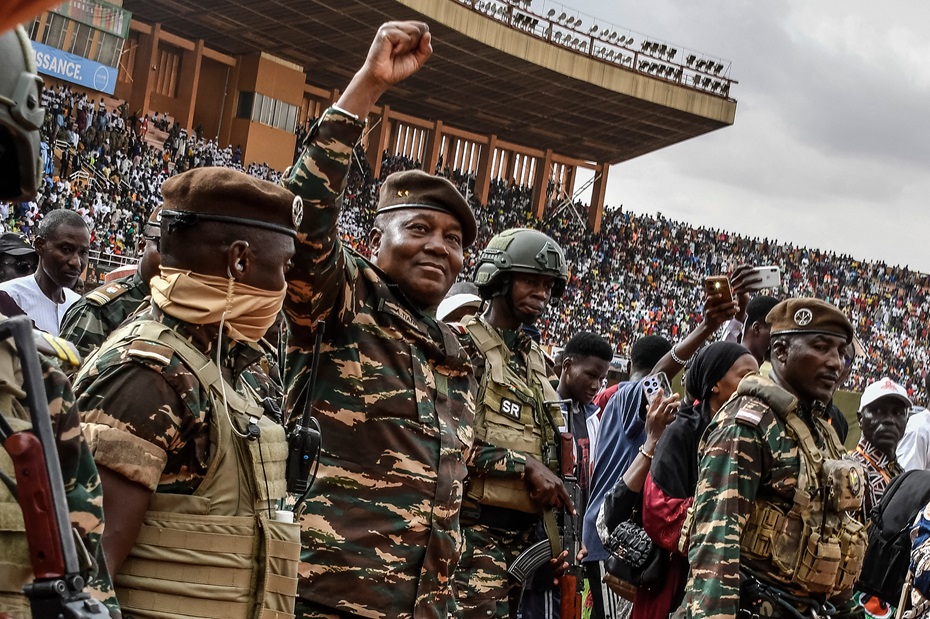
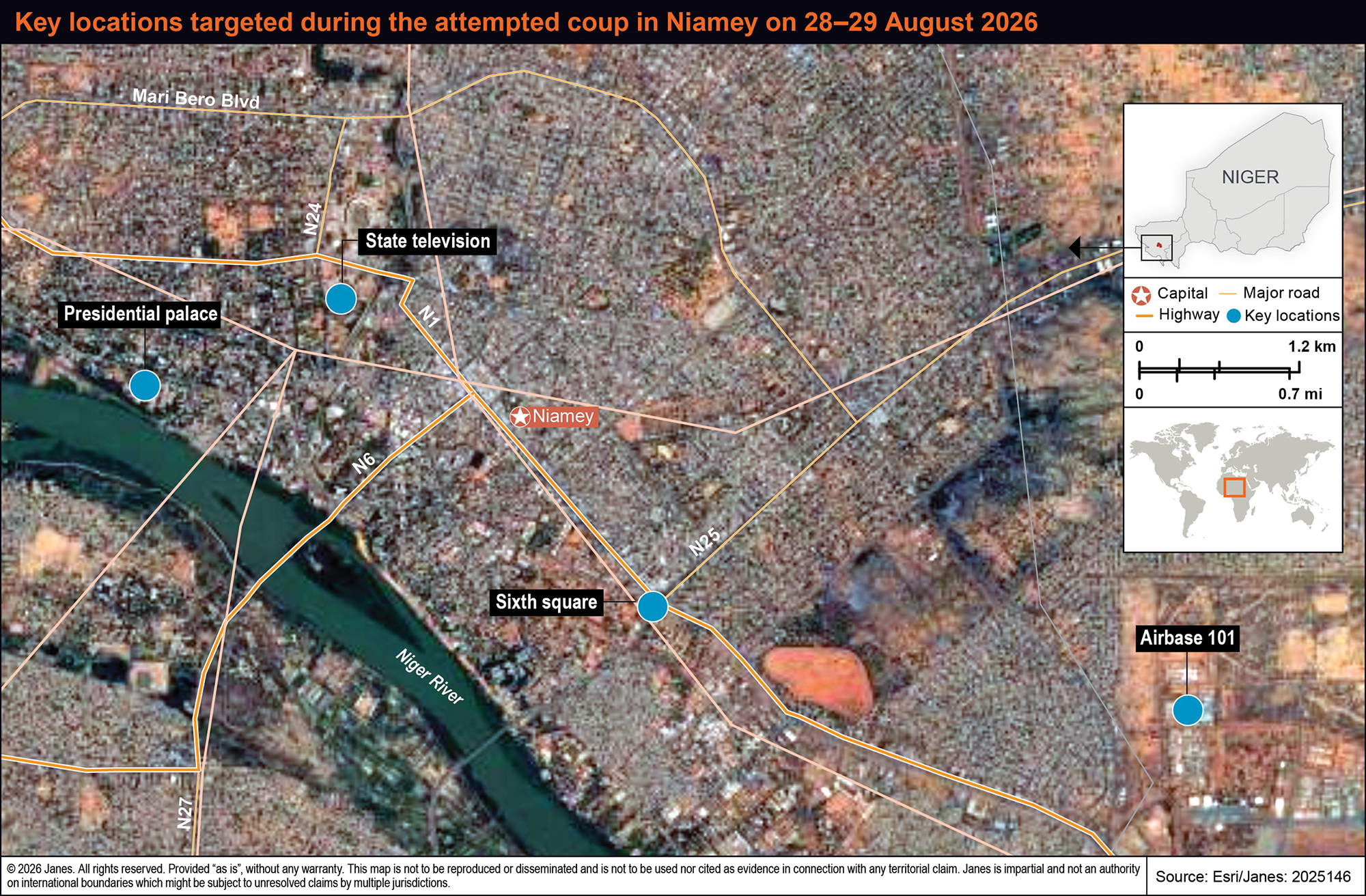 Key locations targeted during the coup attempt in Niamey on 29 August 2026
Image credit: Esri/Janes
The initial fighting occurred on the night of 28 August at the Presidential Palace and Niger’s state television station (Radio Télévision du Niger: RTN), while other troops took positions at key road intersections in the city, including at Sixth Square (Sixième Square). The Presidential Guard (Garde Présidentielle) repelled the attacks, with the FAN troops retreating to Airbase 101, Niamey’s primary military installation. A combined force of Garde Présidentielle troops and Russian Ministry of Defence personnel, known as Africa Corps, reduced the FAN positions at Airbase 101 until those troops surrendered the following day.
Significance
The attempted coup indicates a deterioration of relations between the FAN and the CNSP government of Niger and increases the risk of the instability in Niger. It is likely that this deterioration of relations has been driven by ongoing grievances such as low pay and operational set backs damaging morale.
The coup attempt by troops based in Ouallam, Tera, and Dosso, which are all important centres of combat operations against Islamist militant groups in south-western Niger, indicates evidence of likely grievances by some FAN officers against the CNSP government.
One grievance of FAN troops has been pay. German news agency Deutsche Welle (DW) quoted Dr. Abdoulaye Sounaye, a specialist in religion, state and society in West Africa, especially Niger and Nigeria, on 31 August, saying that most FAN personnel are paid less than USD170 per month, where the median salary is roughly USD132 according to International Labour Organization (ILO) 2022 figures. Additionally, reporting by Radio France Internationale (RFI) over 2025 indicated that FAN personnel also suffer delays in receiving pay.
Casualties sustained in fighting with militant Islamist groups the Islamic State’s Wilayat al Sahel, and the Al-Qaeda affiliate Jamaat Nusrat al-Islam wal-Muslimin (JNIM), have also very likely degraded the FAN’s morale. Janes recorded 1,266 security forces fatalities between the coup in 2023 and July 2026 at an average of 33 per month. This is compared with an average of nine fatalities per month over the three years prior to 2023, with a total of 331.
The FAN has also faced operational setbacks in 2026, including a successful attack by Wilayat al-Sahel on Airbase 101 in January, that destroyed fixed-wing and rotary-wing aircraft. Additionally, Janes recorded that Wilayat al-Sahel expanded its area of operation eastward toward Niamey from an area that had been closer to the Malian and Beninese borders, over 2025 and 2026, despite FAN operations.
Mutinies by FAN units over 2025 and 2026 provide further evidence of grievances. In May 2025, a FAN unit at a base near the town of Termit, Zinder region, took its officers captive and demanded talks with the Ministry of National Defense. RFI reported on 12 May that the soldier's grievances included inadequacies in equipment, delays in the disbursal of salaries and bonuses, and malnutrition.
Another mutiny, which occurred at two FAN bases, one near the town of Téra, the garrison of which was part of the coup attempt on 29 August, and one at Filingué, both in Tillaberi region. A June 2025 article by RFI reported that both garrisons refused to conduct missions, and that the troops at Téra demanded “suitable weaponry, reliable intelligence, salaries paid on time and above all, plenty of ammunition.” It added that those at Filingué demanded more resources and air support.
The most recent example, and evidence that disgruntlement within the FAN has not eased significantly since the mutinies of 2025, was the refusal of a unit to deploy from Niamey to forward operating bases in Tillabéri Region in July 2026. A 5 July article by Nigerian news outlet, The Daily Post, reported that the troops cited “inadequate heavy equipment and insufficient operational resources to tackle worsening security threats.”
Outlook
It is likely that FAN officers will attempt a coup again over the medium-to-long term. This is because despite mutinies over 2025 and 2026, the CNSP government have failed to improve the morale of FAN officers.
That the CNSP has not taken action to improve FAN morale indicates the government lacks either the intent or capability to make improvements in this area. The risk to the stability of Niger from this civil-military divide is therefore likely to increase over the long term. The loyalty of the Garde Présidentielle during the coup attempt and the successful intervention of Africa Corps personnel, mitigate the risk of a coup attempt succeeding.
Risk positive indicators
- Armed forces reform, including increases in the amount and regularity of pay. This would indicate that one of the key grievances of FAN personnel is being addressed and likely reduce the motivation of personnel to make another coup attempt.
- A decline in FAN casualties on operations against non-state armed groups (NSAG). This would very likely reduce the perception of the risk from combat operations by FAN personnel and therefore reduce the instances of personnel refusing to go on missions.
Risk negative indicator
- Sustained or increased armed forces casualties on operations against NSAGs. This would very likely indicate the relationship of many FAN personnel with the government is likely to worsen, as it would very likely represent further operational failures and likely highlight the weak state of the FAN’s equipment.
- Further mutinies in forward bases or from troops about to deploy on operations. This would be a strong indication that that FAN personnel remain disgruntled, as such mutinies are have been accompanied by claims that participating troops are short of either pay, equipment, or food.
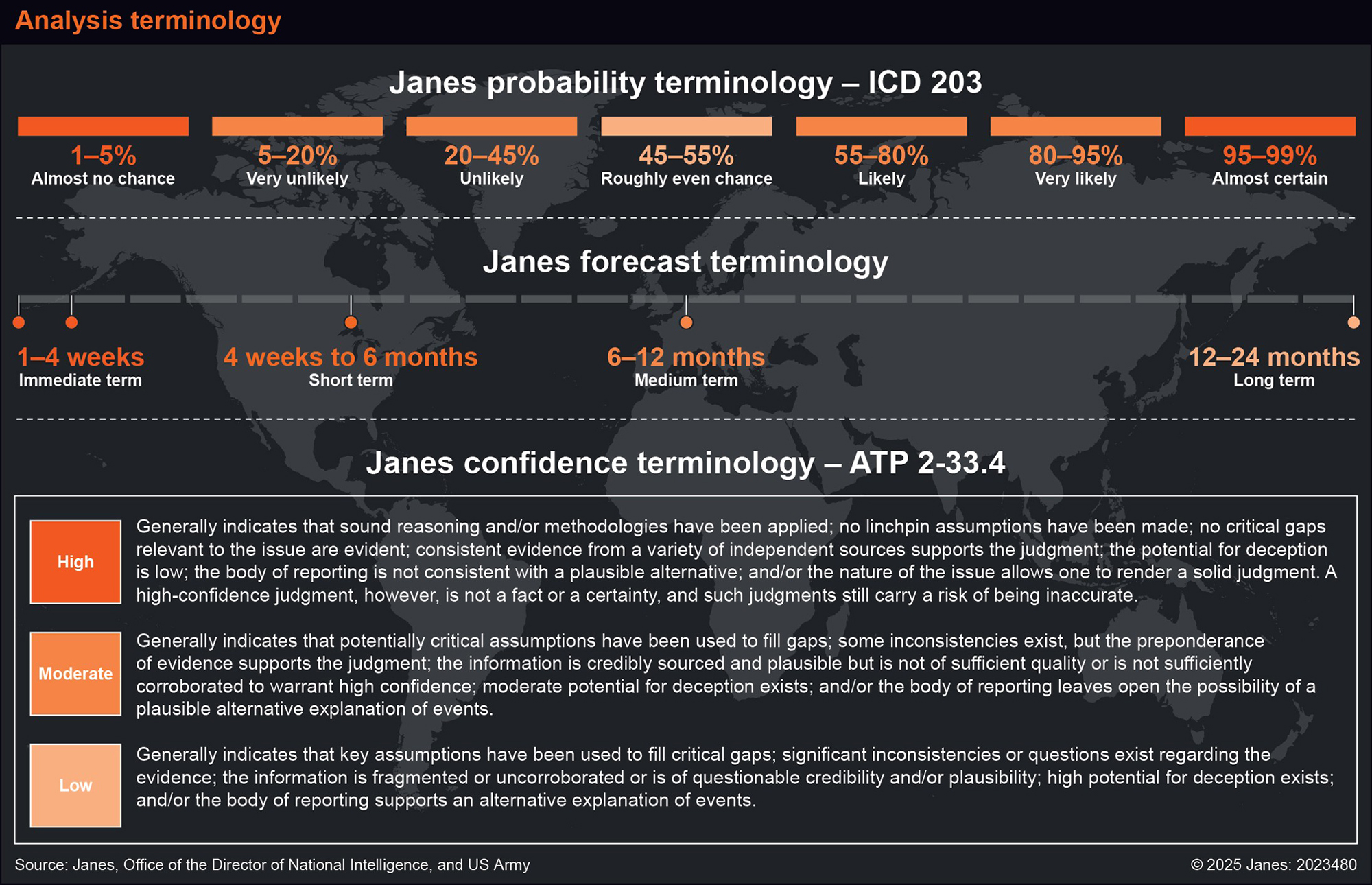 Analysis terminology
Image credit: Janes