China’s strategic signalling intensifies in the Pacific as PICs leverage security treaties with Australia
Key assessments
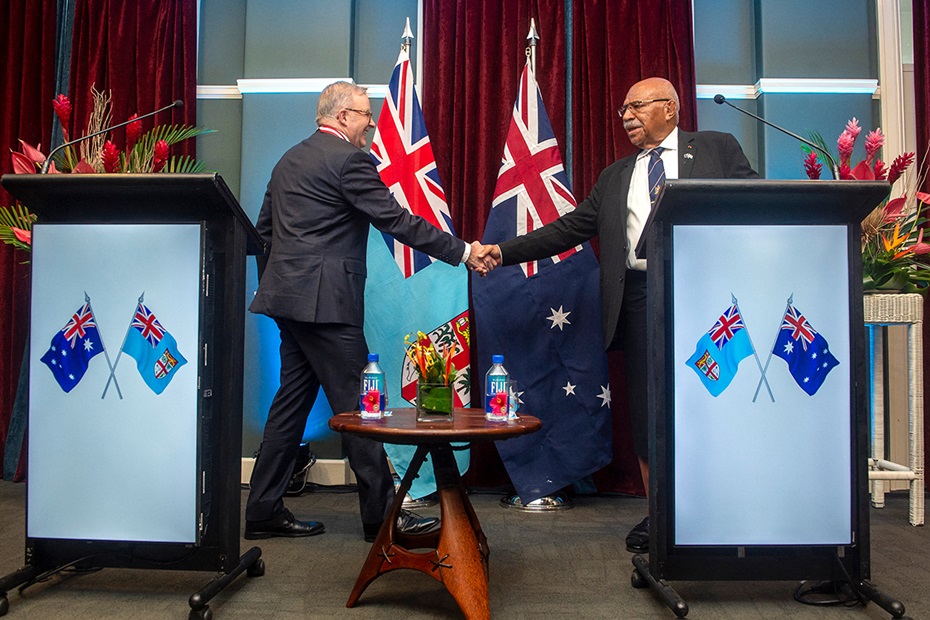
- The Pacific Island Countries are very likely to continue to strategically engage with both Beijing and Canberra, leveraging Australia’s bilateral security agreements and China’s economic engagement across the region.
- Australia’s expanding network of regional bilateral treaties is likely to reduce the probability that China can secure formal military access in key PICs. However, Beijing will likely retain influence through non-military engagements.
- China’s strategic missile test launch on 6 July is likely to reinforce PICs concerns regarding strategic competition and external militarisation of the region.
Context
In a span of 10 days, Australia signed defence agreements with two Pacific Island Countries: The Nakamal Agreement with Vanuatu on 29 June, followed by Ocean of Peace Alliance with Fiji on 6 July. A few hours after the Australia-Fiji deal was signed, a Chinese submarine launched a nuclear-capable long-range missile with a dummy warhead into the South Pacific Ocean, Chinese state-owned media outlet Xinhua reported. The report also mentioned that the relevant regional governments were notified in advance and that the missile test was “a routine part of China’s annual military training program... in accordance with international law and practice and [was] not directed against any specific country or target.”
Read more on China's missile test launch here: China launches strategic missile from nuclear submarine into Pacific
Chinese SLBM launch in July 2026: Chinese missile and satellite tracking ship, Yuanwang 5, sighted operating from Port of Suva (Fiji) in early July 2026
Australia’s treaties with Fiji and Vanuatu follow its Pukpuk Treaty with Papua New Guinea (6 October 2025), the Australia-Nauru Treaty (9 December 2024), and the Tuvalu Falepili Union treaty (9 November 2023). Australia is set to begin negotiations on a comprehensive treaty with Solomon Islands, as noted in the 3 July 2026 joint statement by prime ministers Anthony Albanese and Matthew Wale.
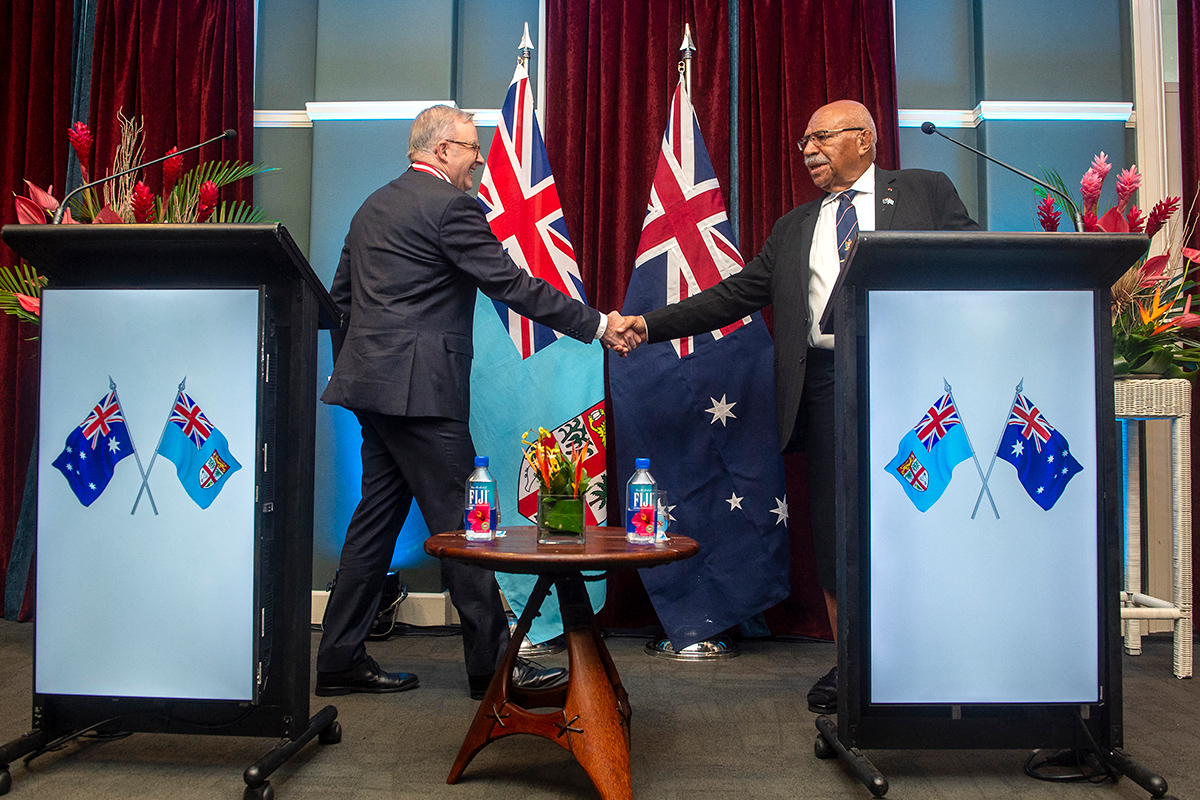 Australian Prime Minister Anthony Albanese (L) and Fiji's Prime Minister Sitiveni Rabuka (R) shake hands after a joint press conference at the Grand Pacific Hotel in Suva on July 6, 2026. Australia signed a new defence alliance with Fiji on 6 July 2026, bolstering ties with its South Pacific island neighbour.
Image credit: Leon LORD/AFP via Getty Images.
Key assessments
Assessment 1: The Pacific Island Countries are very likely to continue to strategically engage with both Beijing and Canberra, leveraging Australia’s bilateral security agreements and China’s economic engagement across the region.
Janes assesses with high confidence that Australia is constructing a network of bilateral security treaties across the Pacific, but PIC governments continue to view these arrangements primarily as instruments for strengthening national resilience rather than as anti-China alignment mechanisms. The agreements provide security, policing, climate, disaster-response, labour-mobility, and economic benefits while allowing most PIC governments to preserve engagement with other major partners, including China. As a result, Australia’s expanding treaty network is unlikely to end the PICs’ broader strategy of strategic hedging and multi-alignment.
Vanuatu is the clearest example of this strategic hedging. Port Vila delayed the Nakamal Agreement because earlier language was viewed as potentially restricting sovereignty and access to third-party infrastructure finance. The final version adopted on 29 June mentioned ‘consultation' over critical infrastructure rather than Australian approval. This indicates that Vanuatu accepted Australian security primacy only after preserving policy space for other partners, including China.
The 2025 Pukpuk Treaty with Papua New Guinea, the first for Australia in more than 70 years, and the 2026 Ocean of Peace Alliance with Fiji, contain mutual defence obligation ‘to come to each other’s aid in times of conflict’. Fiji’s decision to sign its first alliance treaty on 6 July does not mean Suva is severing engagement with Beijing, rather its re-balancing towards Australia and traditional partners in security while keeping selective engagement with China. Fiji was the first Pacific nation to formally recognise “One China” principle, a view Fiji reaffirmed in March 2026. Fiji has also retained aspects of its China police co-operation arrangement, despite ending short-term deployments of Chinese officers inside the Fijian police force in 2024.
Similarly, the Falepili Union requires Tuvalu to have mutual agreement from Australia on security or defence-related engagement with other states. But it also includes provisions that Tuvalu will continue to be recognised as a nation-state in the event of climate-related sea-level rise and a permanent mobility pathway for Tuvaluan citizens to live, work, and study in Australia. Likewise, while the Nauru-Australia Treaty includes budget support and policing assistance, Nauru must mutually agree with Australia on third-party engagement in security, banking, and telecommunications.
Read more about PICs’ strategic hedging here: PICs engage in strategic hedging as China increases engagements in Oceania over undersea cables and seabed access
Assessment 2: Australia’s expanding network of regional bilateral treaties is likely to reduce the probability that China can secure formal military access in key PICs. However, Beijing will likely retain influence through non-military engagements.
Janes assesses with moderate confidence that Australia’s growing treaty network is increasing the political and diplomatic costs associated with future Chinese military-access arrangements in key PICs. Treaty provisions in Vanuatu, Tuvalu, Nauru, PNG, and Fiji collectively reduce the opportunities for China to convert economic influence into formal security access. However, China retains significant influence through infrastructure investment, development financing, policing co-operation, trade, and diplomatic engagement. Consequently, competition is likely to shift away from overt military access and increasingly towards economic, technological, and governance-related domains. This follows Janes assessment following the Australia-PNG Pukpuk treaty.
PNG-Australia treaty increases local defence capacity and limits China-PNG relations to economic co-operation
China’s most direct security precedent amongst the Pacific Island Countries remains Solomon Islands. China and Solomon Islands signed a security co-operation framework in April 2022, which both governments framed as supporting social order, protection of life and property, humanitarian assistance, disaster response, and security capacity-building. Solomon Islands’ then-government said the agreement reflected a sovereign decision to broaden security partnerships and was not directed at other countries. Janes latest analysis on China’s engagement with Solomon Islands here:
China’s public security co-operation with Solomon Islands very likely to become a template for regional outreach
However, Janes assesses that China does not require military basing to retain strategic influence. Beijing’s regional engagement includes infrastructure, concessional finance, trade, health, education, policing co-operation, and diplomatic engagement.
Read more about China’s non-military engagement with the PICs here: Insight report: Australia’s strategic engagement in Oceania amid China’s deepening economic and security footprint
China’s response to the Australian treaties has combined diplomatic criticism with continued engagement. After the Vanuatu agreement, China’s foreign ministry stated that co-operation with PICs should not target third parties or be used for geopolitical contest, while stating that the country would continue co-operation with Vanuatu according to its needs and wishes. Fiji’s Prime Minister Sitiveni Rabuka said he did not expect serious Chinese objections and that the agreement did not threaten Fiji’s relationship with China. In its weekly presser on 6 July, Chinese Foreign Ministry spokesperson Mao Ning stated that China conducts co-operation with Pacific Island Countries on the principles of “mutual respect, equality, mutual benefit, openness and inclusiveness” and does not engage in geopolitical rivalry. Mao also stated that countries engaging with PICs should respect their independence, focus on sustainable development, and ‘avoid targeting or harming the interests of third parties’.
Hence, the missile test launch on 6 July is likely to complicate China’s regional narrative. Beijing has consistently framed its Pacific engagement as development-oriented, sovereignty-respecting, and non-confrontational. An SLBM test into the South Pacific, particularly if conducted shortly after several PICs have signed or are negotiating security agreements with Australia, risks reinforcing perceptions that China’s regional role also includes coercive or full-spectrum military signalling. This is particularly relevant for PICs that identify climate change as their primary security challenge and view nuclear-free regionalism as a core security norm.
Janes assesses with moderate confidence that Australia’s treaty network will constrain Chinese military-access pathways more effectively than it constrains Chinese economic or institutional influence. However, the reported SLBM test is likely to make China’s military signalling more salient in PIC threat perceptions and could strengthen political support for Australia’s framing of Pacific-led security. The principal regional-security risk is therefore likely to shift from overt basing alone to a broader competition involving treaties, infrastructure finance, policing, digital systems, and long-range military signalling.
For more information, please see China’s strategic signalling intensifies in the Pacific as PICs leverage security treaties with Australia