China fields EW‐equipped BZK‐005 UAV variants for long‐range ELINT operations
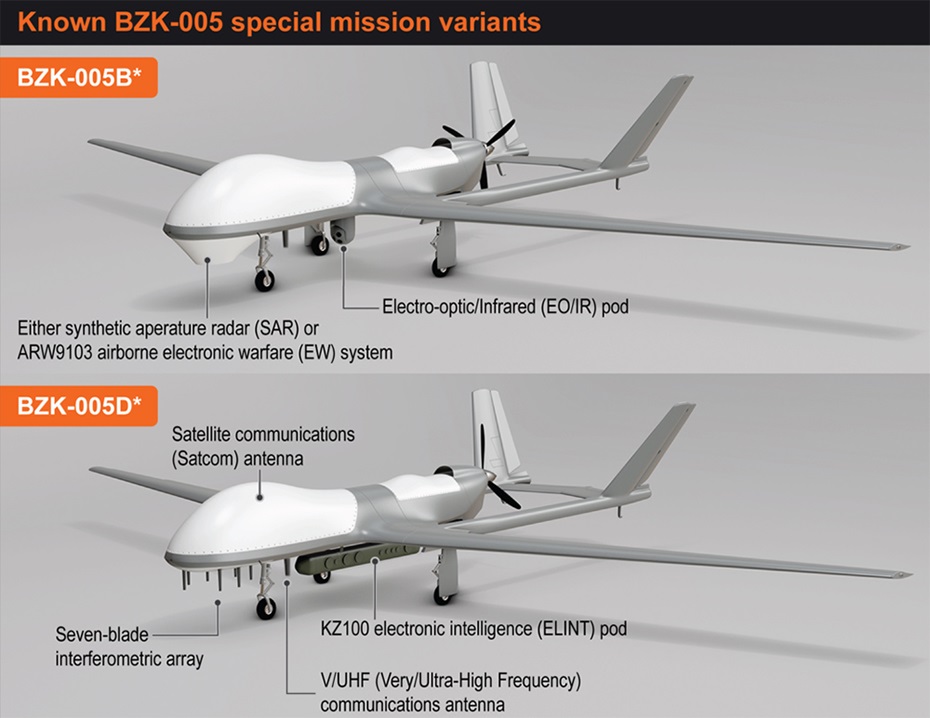
New details have emerged regarding electronic intelligence (ELINT) and electronic warfare (EW) systems integrated with the Beihang BZK-005 unmanned aerial vehicle (UAV) in service with the People’s Liberation Army (PLA).
A fixed-wing and twin-boom design, the medium-altitude long-endurance (MALE) BZK-005 is an unmanned intelligence, surveillance, and reconnaissance (ISR) and electronic intelligence (ELINT) platform operated by China. The Chinese People’s Liberation Army (PLA) has employed the type for long-range operations over the Bashi Channel, Taiwan Strait, East China Sea, the Miyako Strait, and the western Pacific, according to information published by the Japanese Ministry of Defence (MoD) and Taiwan’s Ministry of National Defense (MND).
Janes has identified at least three special-mission configurations of the UAV. The baseline BZK-005 entered PLA Navy (PLAN) service in 2009, while the PLA Air Force (PLAAF) is assessed to have acquired the type in 2007. Official Chinese literature on domestically developed systems, obtained by Janes, provides details of an ELINT pod and an airborne EW system that are likely integrated with the platform.
The earliest of the three specialised BZK-005 configurations had appeared in PLA service by 2017, according to Janes data. This variant features a modified undernose fairing capable of housing an EW system and has been tentatively designated by Chinese military observers as the BZK-005B.
In August 2024, the Japan MoD published a photograph of a previously unknown BZK-005 variant conducting an operational flight near Japan. The image showed a UAV, tentatively designated as the BZK-005D, equipped with a centerline ELINT pod. In September 2025, a third variant featuring slimmed-down ELINT pods appeared in footage broadcast by Chinese state-owned media.
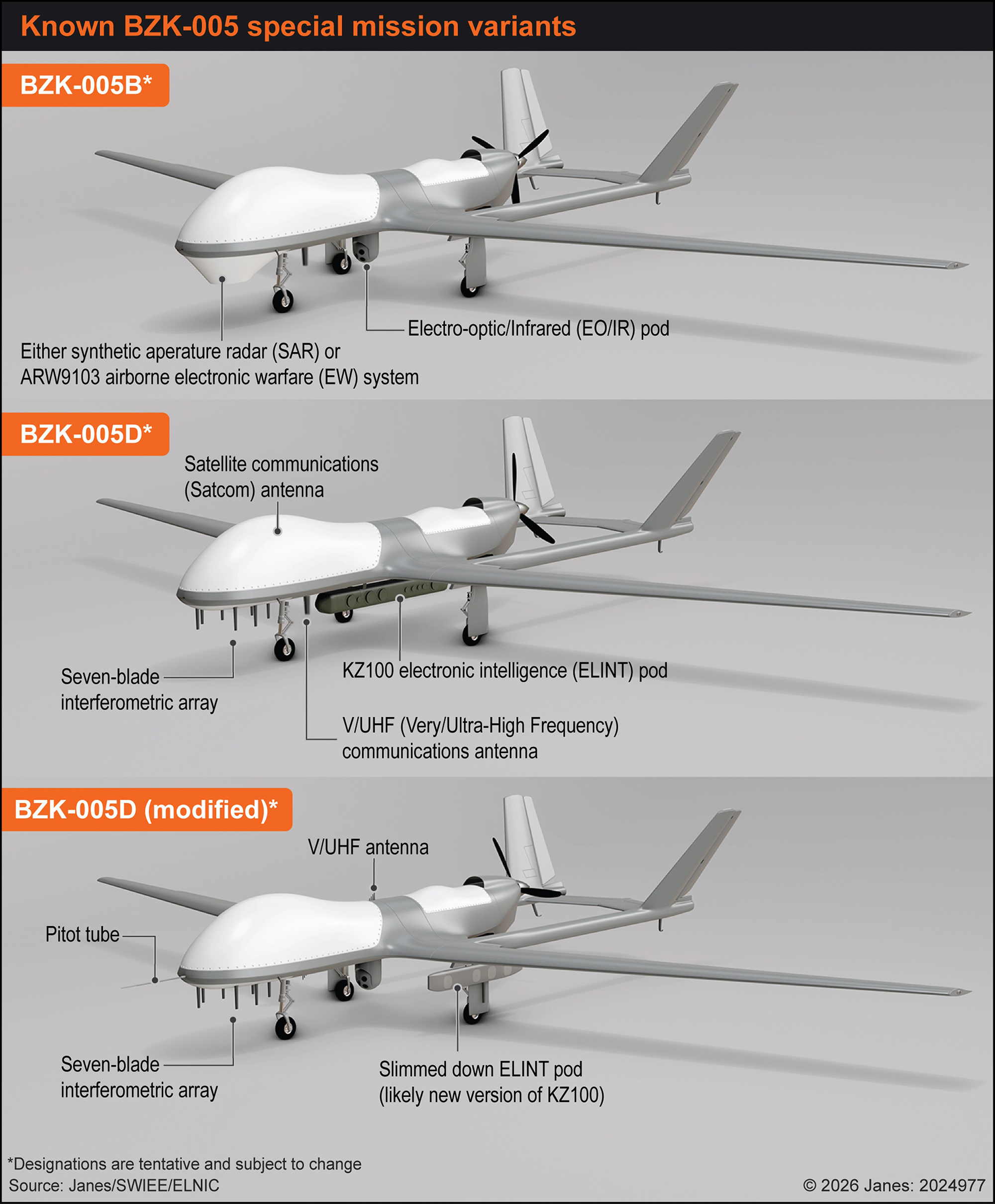 This infographic shows the three known BZK-005 special mission variants in service with the People's Liberation Army. Image credit: Janes
BZK-005D
Footage of the BZK-005D published by Chinese state-owned media shows that its centerline pod is visually similar to the KZ100 ELINT pod.
Developed for MALE UAV platforms by the state-owned Southwest China Research Institute of Electronic Equipment (SWIEE), the KZ100 is designed to detect electromagnetic emissions from radar systems and to acquire technical parameters and positions of those systems, according to SWIEE literature. SWIEE is a subsidiary of the China Electronics Technology Group Corporation (CETC).
The pod is capable of wide-band coverage from L- to Ku-band and enables accurate parameter measurement as well as rapid direction finding (DF), according to SWIEE.
The BZK-005D variant is also fitted with a seven-blade interferometric antenna array, assessed to support communication intelligence (COMINT) applications. This array likely enhances the pod’s DF capability and is used to identify and geolocate radio frequency (RF) emitters operating across a typical frequency range of approximately 25 MHz to 2 GHz, Janes assesses.
BZK-005B
Several BZK-005B units are assessed to house a synthetic aperture radar (SAR) for maritime reconnaissance within the platform's undernose fairing. However, the fairing can alternatively accommodate the ARW9103 airborne EW system, according to information published by ELINC, a Beijing-based subsidiary of the state-owned China Electronics Corporation (CEC).
The ARW9103 adopts a modular EW bus architecture and a modular design, and provides radar reconnaissance, radar warning, and active jamming capabilities, according to ELINC. In its radar reconnaissance configuration, the ARW9103 operates across a frequency range of 0.8 to 18 GHz, provides 360-degree azimuth coverage, and achieves a positioning accuracy of 3% of system range (circular error probability, CEP), the company added.
In radar warning receiver (RWR) mode, the ARW9103 can detect target acquisition, fire control, seeker, and other radar types. According to ELINC, the onboard sensor has a warning range 1.2 times that of the detected adversarial radar system, with 360-degree azimuth coverage. The frequency range in this mode extends from 2 to 18 GHz and into the millimetre-wave band.
In active jamming mode, the ARW9103 has a frequency range of 2 to 18 GHz and an effective radiated power of 20W. The mode includes barrage and deception jamming.
BZK-005D modified
In September 2025, state-owned China Central Television (CCTV) aired images of the third variant. This was a new BZK-005D configuration, equipped with slimmer underwing ELINT pods featuring sensor arrangements similar to those of the KZ100.
The KZ100 pod is notable for incorporating four large radial shaped, side-facing antennas and four smaller radial side-facing antennas along its length. These are likely associated with an active electronically scanned array (AESA) system. The CCTV footage showed the new slimmed-down underwing pods fitted with four large circular antennas and six smaller side-facing antennas.
Janes previously assessed that the replacement of the single ELINT pod with two underwing pods is likely to mitigate electromagnetic interference/electromagnetic compatibility (EMI/EMC). Separating receiving antennas across two pods also improves the direction-finding (DF) accuracy of RF emitters when employed for geolocation of adversarial systems.
This new variant of the UAV also possesses the ventral seven-blade interferometric antenna array seen on the BZK-005D, according to CCTV footage. The broadcaster reported that the variant is in PLAN service.
This article includes information provided by senior C4ISR analyst Ajay Shankar Pandey.
For more, please see:
Analysis: New Chinese BZK-005 version breaks cover in operations near Japan
Feature: China accelerates air combat modernisation