Kremlin Insider: Russia escalates rhetoric and hybrid pressure against Europe while deepening non-Western ties
Political and economic engagement
Russia’s external political and economic engagement has become more adversarial towards Europe while broadening elsewhere. Janes analysis indicates that high-ranking Russian political figures almost doubled (80% increase) threatening rhetoric towards key European states between September 2025 and April 2026 compared with January to August 2025. Although the share of negative statements declined over the same period, this largely reflected the increase in explicitly threatening language, not a genuine moderation in Russia’s baseline position towards Europe.
Putin’s direct engagement patterns and Russian government-level economic outreach point to a sustained reorientation away from Western states and towards former Soviet states, Asia Pacific, the Middle East and North Africa, and selected partners in Sub-Saharan Africa. Former Soviet states remained the Kremlin’s most frequent interlocutors over 2021–25, while APAC and MENA became more prominent after Russia’s isolation from much of the West. Türkiye remained an important outlier among Russia-trading Western states. Economic engagement also broadened in 2025 and remained elevated in early 2026, shifting from trade promotion and intergovernmental forums towards more practical delivery on energy, trade, investment, logistics, tourism and financial coordination, primarily with partners in Asia, the Middle East and Africa.
Threatening rhetoric and diplomatic activity
Russia’s intent and threatening rhetoric toward key European states
Janes analysed 643 statements relating to key European states by 15 high-ranking Russian political figures between January 2025–April 2026, and classified the statements by sentiment (threat, negative, neutral, or positive). Statements classified by Janes as “threat” involve any type of Russian implicit or explicit threat of war, military escalation, or other retaliation against European states.
Janes selected the following 15 Russian politicians based on seniority and impact on foreign policy:
- Russian President Vladimir Putin,
- Minister of Foreign Affairs Sergey Lavrov,
- Deputy Prime Minister Aleksandr Novak,
- Deputy Minister of Foreign Affairs and former Permanent Representative to NATO Aleksandr Grushko,
- First Deputy Prime Minister Denis Manturov,
- Aide to President Vladimir Medinsky,
- Prime Minister Mikhail Mishustin,
- Deputy Chairman of Russian Security Council Dmitry Medvedev,
- Secretary of the Security Council Sergey Shoigu,
- Aide to President Nikolai Patrushev,
- Deputy Foreign Minister Sergey Ryabkov,
- Minister of Finance Anton Siluanov,
- Permanent Representative to International Organizations Mikhail Ulyanov,
- Aide to President Yury Ushakov, and
- Foreign Ministry Spokesperson Maria Zakharova.
Although statements tagged as having a ‘negative sentiment’ show a 19.5% decrease from January–August 2025, with 278 statements (85.5% of total), to September 2025–April 2026, with 224 statements (77.2% of total), statements tagged as ‘threat’ increased by 80% in the same period. In addition, Janes considers negative sentiment statements as Russia’s baseline position.
Examples of implicit or explicit threats by select political figures include:
- Putin’s statement on 2 December 2025: “If Europe suddenly wants to start a war with us and starts it, it would end so swiftly for Europe that there would be no one to negotiate with in Europe.”
- Lavrov’s statement on 11 December 2025: “for majority of political leaders, like Macron, Merz, Starmer, Tusk, Stubb, von der Leyen, Kallas, a quick resolution of the conflict is not beneficial ... they fantasise dispatching their military personnel to Ukraine as peacekeepers, for us these so-called peacekeepers will immediately become legitimate targets”
- Zakharova’s statement on 15 January 2026: “in the event of attempts to implement the ... coalition of the willing the responsibility for the lives of British subjects will lie entirely with London.”
- Shoigu’s statement on 16 April 2026: speaking on Ukrainian UAV incidents, said this could mean the NATO states involved were “deliberately providing their airspace”, acting as “direct accomplices in aggression against Russia.” He added “in the latter case, in accordance with international law, Article 51 of the UN Charter on the right of states to self-defence in the event of an armed assault comes into force.”
Russia's changing preferred diplomatic partner regions and countries
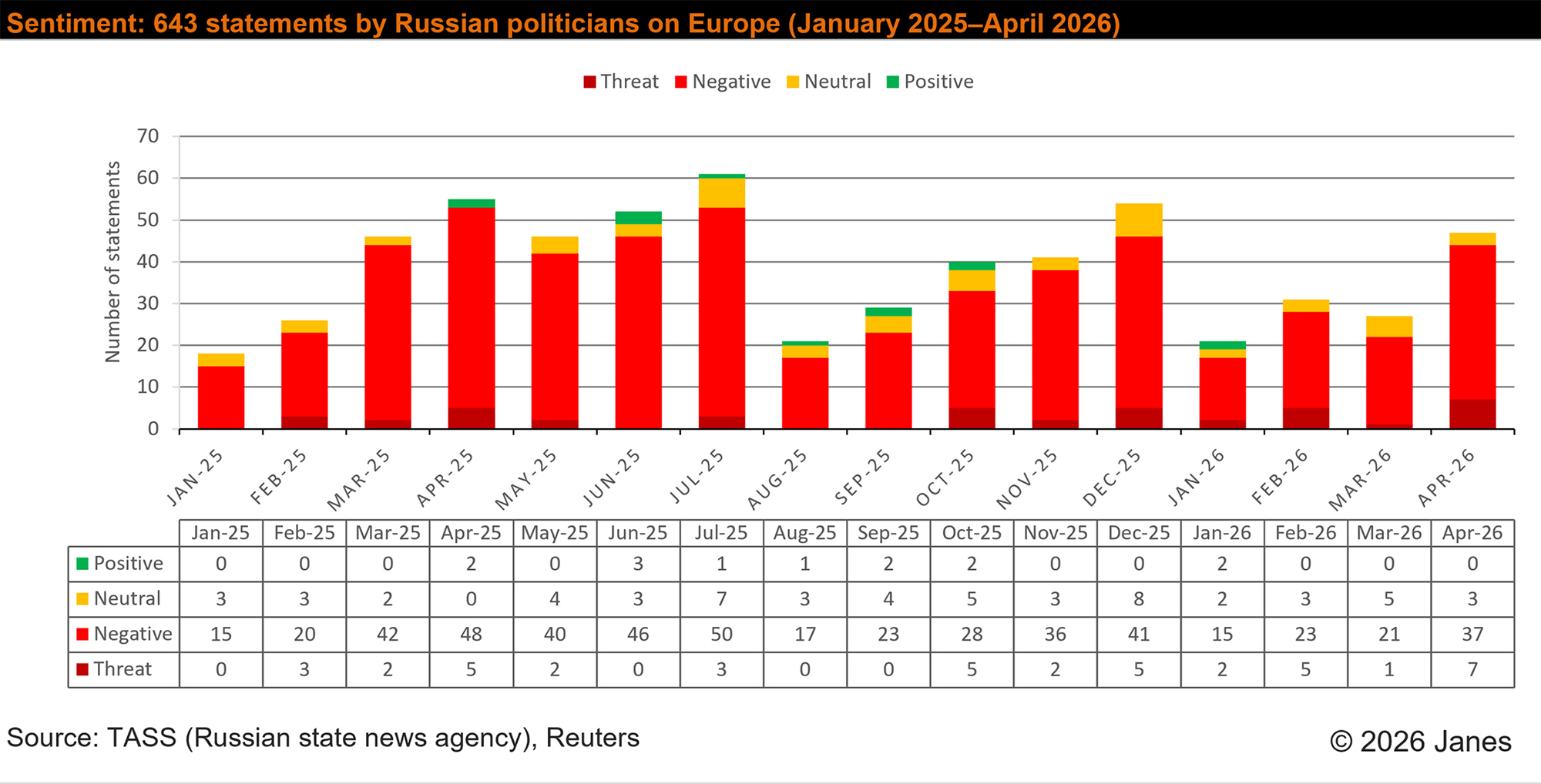 Sentiment: 643 statements by 15 Russian politicians on Europe (January 2025-April 2026)
Image credit: Janes
Janes analysed engagements by President Putin with international political figures (presidents, prime ministers, foreign ministers, defence ministers or special advisors) over five years from 1 January 2021 to 31 December 2025. The five-year period was chosen to include also one full year (2021) of diplomatic engagements prior to Russia commencing invasion of Ukraine (February 2022).
The total of Putin’s 455 engagements with state leaders are segmented into seven regions: countries of Sub-Saharan Africa, Asia-Pacific (APAC), former Soviet states, Middle East and North Africa (MENA), South America, Western states, and Russia-trading Western states (Hungary, Serbia, Slovakia, and Türkiye).
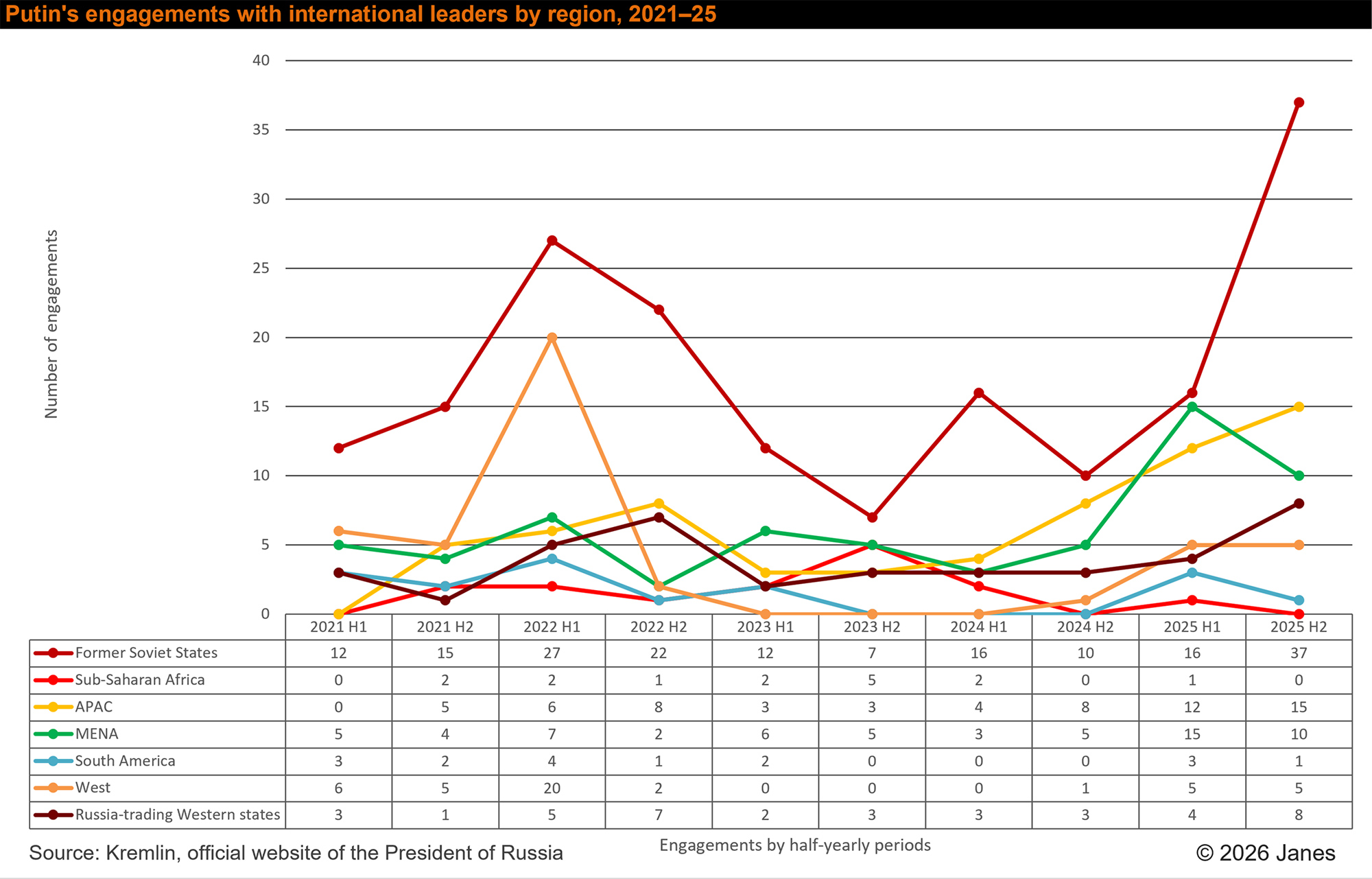 Putin's engagements with international leaders, by regions, 2021-2025
Image credit: Janes
The 2021–25 data show Putin’s engagements with the Western states have fluctuated, from 11 engagements in 2021 (last year before the Ukraine conflict), increasing to 22 in 2022 during the diplomatic efforts to end the conflict. Engagement greatly reduced with the Kremlin’s isolation from the West in 2023 (zero engagements), and 2024 (one engagement, with Germany). The trend increased in 2025 with 10 engagements – all with either US President Donald Trump or US Special Envoy Steve Witkoff.
Former Soviet states remain, due to geographic, linguistic, and historical reasons, the Kremlin’s most frequent interlocutors with 174 engagements over 2021–25 (Belarus 36, Kazakhstan 28, and Uzbekistan 26 engagements). The APAC region has become Putin’s second most important interlocutor, replacing the West, with 64 engagements over 2021–25 (China 19, India 17, and Indonesia nine engagements). The third most frequent interlocutor has become the MENA region with 62 engagements over 2021–25 (Iran 24, Israel 15, and Saudi Arabia 12 engagements). In June 2025, Russia and Iran signed a bilateral Treaty on Comprehensive Strategic Partnership; Russia and Israel have a historically close relationship; Russia and Saudi Arabia co-operate within the OPEC+ organisation of oil producers. An outlier is Türkiye, a NATO state, and classified in this report as “Russia-trading Western state”, which continued cooperating with Russia with 31 engagements with Putin over 2021-2025.
Another trend is Putin’s increasing engagement with APAC countries with four engagements in 2021, 14 in 2022, six in 2023, nine in 2024, and 27 in 2025 (the second highest after former Soviet states).
Economic outreach
Russian government-level economic outreach broadened in 2025 compared with the previous year, and the level of activity remained elevated in the first five months of 2026. Government-level contacts – in the form of meetings and telephone calls between ministers and officials in the Russian ministries of Industry and Trade, Energy, Economic Development and Finance, and their foreign counterparts – also broadened in both thematic and geographic scope.
Based on disclosed engagements reported by Russian government sources, contacts were recorded with 13 countries in 2024, 20 in 2025, and 12 in January to May 2026.
In 2025, the focus was on practical economic delivery: energy, trade, investment, transport, logistics, tourism, and financial coordination, mainly with partners in APAC, the MENAand Sub-Saharan Africa. Compared with 2024, the pattern was broader and more operational. Activity in 2024 centred more on trade promotion, business forums and intergovernmental mechanisms. In 2025, it shifted towards implementation, with energy more prominent alongside trade and investment.
Sub-Saharan Africa
African countries accounted for 23% of Russia’s disclosed overseas contacts on energy, trade, finance and economic cooperation in 2025 and the first five months of 2026.
Russia’s government-level economic contacts in Africa involved Burkina Faso, the Central African Republic, Equatorial Guinea, Ethiopia, Mali, Niger, Tanzania, and Togo. These focused on trade and economic co-operation. Energy was the principal area of activity, featuring in contacts with Equatorial Guinea, Mali, Niger, Tanzania, and Togo. Tanzania also featured in tourism, agriculture, communications, investment and finance, and pharmaceuticals. In Niger, co-operation also covered infrastructure and mining. The pattern combined broad regional energy engagement with more targeted bilateral sectoral initiatives.
APAC
In 2025 and the first five months of 2026, Russia’s government-level economic contacts in Asia were concentrated on China and Myanmar, which accounted for 38% and 24% of recorded contacts respectively. The remaining contacts were spread across Indonesia, Malaysia, Mongolia, India, Pakistan and Sri Lanka.
The main areas of activity were investment, energy, tourism, infrastructure and financial co-operation. Energy featured most prominently, spanning China, India, Indonesia, Myanmar, Pakistan and Sri Lanka. Supply-related discussions also involved China, Mongolia and Sri Lanka. Myanmar was a particular focus, with contacts covering investment projects, infrastructure and financial cooperation. China also featured strongly in financial co-operation as well as travel and tourism; tourism-related engagement also involved Malaysia.
Russia’s contacts with China reflect the political, economic, trade, investment, and financial ties that deepened following the start of the Ukraine conflict in 2022. In Myanmar’s case, the pattern likely reflects parallel isolation from the West and an established exchange in which Russia supplies military materiel and fuel, while Myanmar offers political support, potential diplomatic alignment, and market access.
MENA
In 2025 and 2026, Russia’s government-level economic contacts in the Middle East involved Bahrain, Qatar, the UAE, Oman, Algeria, Libya, Iraq, and Iran. The main emphasis was trade and economic co-operation. Engagement with Libya, Oman, Qatar and Bahrain was broad-based, covering trade, investment, tourism and finance. The UAE stood out for its focus on financial and tax cooperation. Contacts with Iraq and Algeria centred on energy. Engagement with Iran was broader and trade-focused. Overall, the pattern points to commercially oriented diplomacy shaped by distinct bilateral priorities.
For more, please see Kremlin Insider: Russia escalates rhetoric and hybrid pressure against Europe while deepening non-Western ties