Cutting Through the Noise: Interpreting the FY27 U.S. Defense Budget
As the FY27 U.S. defense budget request continues to dominate headlines, much of the early coverage has focused on the topline figure. But behind the “record-breaking” narrative lies a more complex story—one shaped by funding mechanisms, program-level dynamics, and long-term tradeoffs that will define U.S. defense priorities for years to come.
In advance of Janes upcoming, Ahead of Janes flagship webinar, The FY27 U.S. Defense Budget: Trends, Programs, and Industry Implications, Janes Global Platforms and Systems (GPS) Manager, Jesse Berman--who moderates the session--discusses how to cut through the noise, where to look for the most meaningful signals, and what questions defense and industry stakeholders should be asking as the budget process unfolds.
In this interview, Jesse shares his perspective on how to interpret the request beyond the headlines and offers a preview of the key themes the webinar will explore—from cross-service investment trends to what the Future Years Defense Program (FYDP) reveals about sustained priorities versus short-term spikes.
The FY27 request is already being framed as “record-breaking.” When you look past the topline, what are the first signals you focus on to understand what’s really changing and what might just be headline noise?
Jesse Berman: The request is being framed as “record-breaking” because it IS record-breaking. Most people have probably heard about that topline figure of USD1.5 trillion. However, it’s crucial to understand that the administration is using two different types of funding mechanisms to achieve that topline: discretionary and mandatory. Discretionary spending entails the type of spending that the Executive branch requests from Congress each year, while mandatory spending (also referred to as reconciliation) can be thought of as supplemental, one-time funding requests.
“It’s important for readers to reckon with the differences between discretionary and mandatory spending requests, and how this might impact major programs.” - Jesse Berman
Last year’s One Big Beautiful Bill Act included over USD150 billion in mandatory defense spending in FY26. For the FY27 request, it seems the administration plans to use an additional reconciliation bill to fund an addition of USD350 billion for defense beyond the discretionary request. The likelihood of such a significant amount of mandatory spending passing through Congress isn’t guaranteed, despite Republican control.
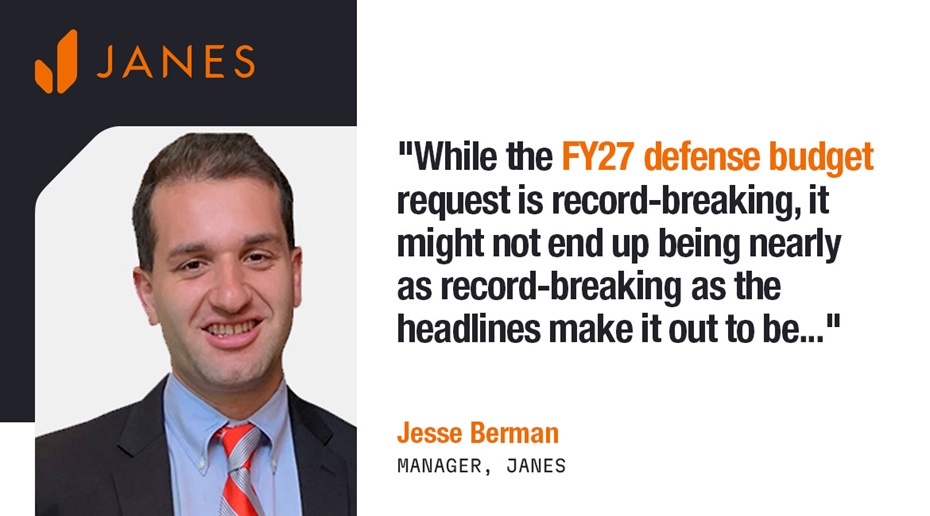
While the FY27 defense budget request is record-breaking, it might not end up being nearly as record-breaking as the headlines make it out to be. The discretionary request alone is record-breaking, coming in at USD1.1 trillion, though there is an open question regarding the future of that additional USD350 billion being requested through reconciliation. Nevertheless, even if Congress doesn’t pass an additional reconciliation bill before the next legislative session, the Trump administration’s request could inform how Congressional appropriators allocate funds during the annual appropriations process.
Now that the request is public, what’s the most important “lens” you want readers to use when they interpret the numbers? Strategy, capability priorities, industrial base realities, or something else? And why?
Jesse Berman: It’s important for readers to reckon with the differences between discretionary and mandatory spending requests, and how this might impact major programs. Let’s look at a few major Air & Missile Defense programs for instance, which have taken on renewed importance amid the conflict with Iran. The U.S. Army’s Terminal High Altitude Area Defense (THAAD) and Patriot Advanced Capability-3 (PAC-3) requests for FY27 are USD11.4 billion and USD12.3 billion, respectively, which are unprecedented in magnitude. However, the discretionary request for THAAD is only USD907 million, meaning that roughly 80 percent of the total request for FY27 is via a funding mechanism that isn’t guaranteed to come to fruition. By the same token, the FY27 discretionary request for PAC-3 is just under USD1.3 billion, meaning that about 90 percent is coming from reconciliation.
It’s also important for readers to look at the rest of the FYDP, which shows anticipated discretionary requests for FY28-31 as well. THAAD and PAC-3 see USD5.8 billion and USD7.5 billion requests in FY28 that grow throughout the FYDP, which also suggests that, even if the reconciliation process does not unfold for the Pentagon as desired, it plans to invest heavily in both programs going forward.
This same lens can also be helpful for analyzing the Golden Dome program, which receives nearly all its funding via reconciliation through FY27 with an expectation that discretionary funds will be utilized from FY28 onwards. In cases of THAAD, PAC-3, and Golden Dome, the usage of the reconciliation process in the near-term could backfire. However, these substantial mandatory figures, coupled with the high level of spending in the FYDP, signal to the public that the administration deems these programs to be a priority.
“It isn’t accurate to simply say that the Pentagon will spend USD1.5 trillion, because we don’t actually know what the Pentagon will be allowed to spend until Congress weighs in...” - Jesse Berman
In the first wave after a budget release, what’s one conclusion people tend to jump to too quickly, and what context is essential before anyone labels a program area a “winner” or “loser”?
Jesse Berman: It’s crucial to remember that the annual Presidential Budget Request (PBR) is simply that: a request. Many observers might take the headline figures (i.e. USD1.5 trillion) and make certain assumptions about the magnitude of U.S. defense spending based solely on the PBR and fail to take into account that, above all, the PBR/FYDP is a messaging document to Congress—who ultimately has the power of the purse—about what the administration prioritizes.
For FY27, it isn’t accurate to simply say that the Pentagon will spend USD1.5 trillion, because we don’t actually know what the Pentagon will be allowed to spend until Congress weighs in, either via a reconciliation bill and, ultimately, through the annual appropriations process. I would advise observers to wait until Congress has had its say via its constitutionally mandated role as the appropriator before making general assumptions about the size of the defense budget and the many programs housed within it.
It’s crucial to ingest the FYDP as a step in the budgeting process, albeit a major one, and not the finish line. Once Congress has its say during FY27 appropriations later this year, we’ll be able to determine with far more certainty which programs have “won” or “lost” in this year’s budget cycle.
Since this process will likely not occur until around December at the earliest (despite the fiscal year ending at the end of September), we can ask ourselves several questions to determine whether or not a program is “winning”: where is funding coming from (i.e. discretionary v. mandatory), what is the FYDP signaling (i.e. is FY27 a one-time spike/dip or will it last), how does the request stand relative to other programs in the same service, and how has Congress treated the program during the Appropriations process in the past?
The budget story doesn’t stop at FY27. How should readers connect the FY27 request to the FYDP to understand the trajectory into 2027–2031 and beyond, especially if they’re trying to gauge staying power vs. one-year spikes?
Jesse Berman: The Trump administration has stated that its FY27 request, when including mandatory funding, will serve as a “generational” investment in the military. As such, it isn’t surprising that FY28 experiences a significant drop-off that persists through the remainder of the FYDP. This trend occurs not only because of lower total funding after the USD1.5 trillion peak in FY27, but also because the Pentagon plans to dedicate funds to personnel and sustainment, away from procurement and development, to ensure that new platforms acquired in the near-term will have the proper upkeep and manpower.
While we expect a major fall-off after FY27, it’s important to recognize the elevated spending floor relative to the years before the second Trump administration. Although investment spending is expected to decline by over 27 percent between FY27-28 from about USD760 billion to about USD555 billion, that latter figure is still nearly double that of FY25, which was the final request year of the Biden administration. Even though FY28 will see a decline, overall spending remains meaningfully higher on the whole under the Trump administration.
“The key is separating one-year spikes from longer-term commitments, especially when funding mechanisms and procurement cycles can distort the topline.” - Jesse Berman
It’s also worth noting that certain programs, namely shipbuilding, experience funding spikes from year-to-year by nature. For instance, the FYDP shows the Navy’s Shipbuilding subaccount rising 52 percent between FY26-27 before falling by 2.5 percent in FY28—and a much larger 24.5 percent in FY29 ahead of a 26 percent spike in FY30. This type of unconventional funding cycle is quite typical for this specific account and is a feature that the Janes GPS team tries to replicate in outyear forecasts beyond FY31.
You moderate the new Janes webinar, The FY27 U.S. Defense Budget: Trends, Programs, and Industry Implications. What topics does the webinar cover, who should attend, and what insights will attendees gain from the session?
Jesse Berman: To understand where the FY27 request is really heading, you must look beyond the headline figure and examine what’s sustained versus what’s temporary. While FY27 is framed as a “generational” investment, the outyears tell a more nuanced story—where spending moderates, but priorities remain elevated across key programs.
The key is separating one-year spikes from longer-term commitments, especially when funding mechanisms and procurement cycles can distort the topline. For more than 20 years, Janes has delivered this level of insight to customers, with our flagship webinar helping them cut through headline noise and understand the full complexity of the defense budget.
In the webinar, we’ll break down those dynamics across the entire force—Army, Navy, Marine Corps, Air Force, Space Force, and defense-wide agencies—highlighting where funding is likely to persist, where there’s risk, and what it means for capability development and the industrial base. It’s designed for defense and government professionals, industry leaders, and analysts who need a clear, actionable view of what the FY27 request really signals for the years ahead.